2026 Enterprise IT: GenAI's Shift from Adoption to Operation
For 2026, GenAI investment is no longer about 'if' but 'how to operate.' Learn to move beyond pilots to real ROI with effective data, governance, and operational strategies.
If you're unsure how much generative AI to include in next year's budget, you're already at a crossroads. While competitors boast about AI agent implementation successes, your team might still be running its third PoC. The real anxiety here isn't 'Is it too late if we don't start now?' but rather 'Why did we try it, and what did we gain?'
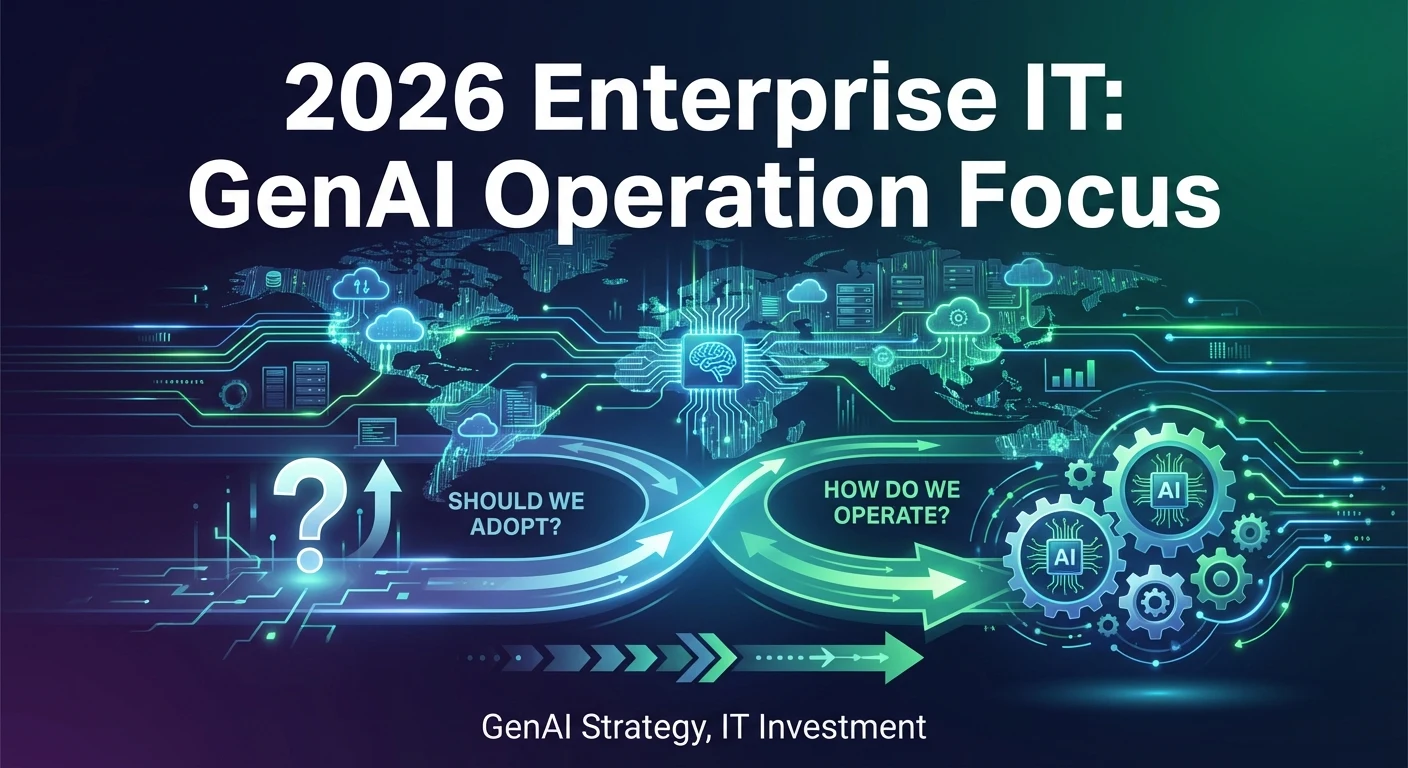
The trend for 2026 is clear in the numbers. CIO forecasts predict global IT spending will increase by 10.8% year-over-year to reach $6.15 trillion, with AI infrastructure at the core of this growth. A Samsung SDS survey revealed that 70% of Korean companies plan to increase their investment in GenAI and AI agents. This isn't just a trend; it's backed by data.
However, a surge in budget doesn't guarantee results. In a market flush with investment, the real question isn't 'Did you buy AI?' but 'Is it actually working within your organization?'
Why GenAI Became Central to Enterprise IT Investment
If cloud migration defined an era, generative AI has now taken its place. CIO surveys show generative AI becoming the top investment technology from 2024, surpassing cloud with 59.3% in 2025.
This shift isn't just a fleeting trend. Generative AI isn't merely a tool for a single department; it's becoming a shared infrastructure impacting multiple departments simultaneously, from document creation and search to customer support, knowledge discovery, and repetitive task automation. Thus, 2026 IT investment is less about buying more servers and more about discerning which tasks, when augmented with AI, will genuinely improve speed and quality.
How Much Can We Trust ROI Figures?
There's certainly evidence of positive outcomes. A Deloitte survey found that many companies reported higher-than-expected ROI from generative AI, with 78% planning to increase their AI budgets the following year. A Snowflake survey also indicated that 92% of generative AI early adopters reported positive ROI, with an average of 41%.
However, it's risky to jump directly from these numbers to "we should invest heavily too."
Caution: While these ROI figures serve as valid market signals, it's important to remember they are primarily from early adopters. Perceived outcomes can vary significantly depending on industry, data quality, and internal approval processes.
Ultimately, the core question isn't "How much should we invest?" but "Where should we start investing?"
Impact Is Found in Narrow, Specific Tasks
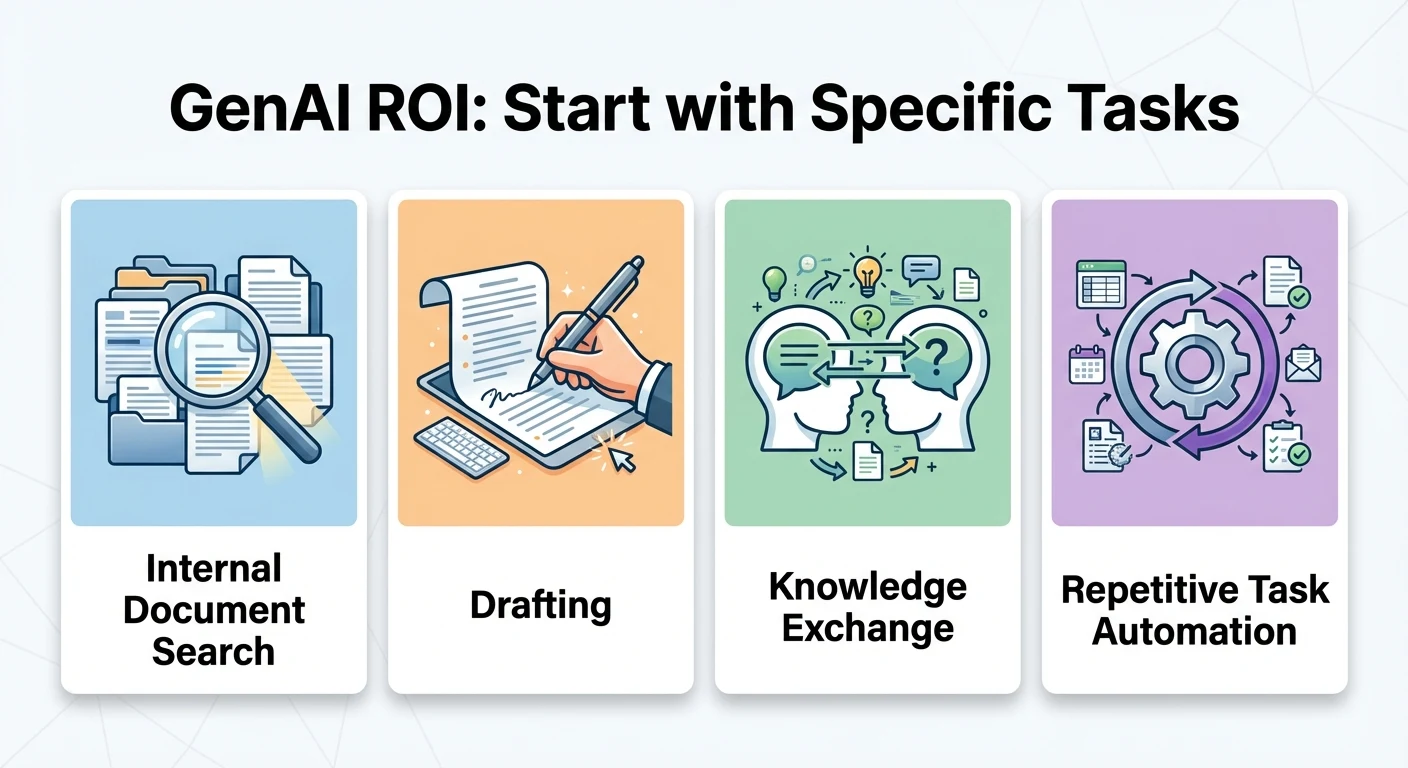
Companies that have successfully demonstrated ROI typically began with a narrow scope. Rather than declaring an organization-wide AI transformation from the outset, they tackled tasks involving high volumes of documents and knowledge exchange, or those with high repetition rates.
Good starting points include tasks where time-saving effects are easily measurable, such as internal document search, drafting proposals, summarizing meetings, or responding to customer inquiries. The goal isn't to "replace people" but to empower employees to make faster decisions and miss fewer details.
The same applies to AI agents. While agentic AI is gaining attention as a candidate for tangible value creation, operations can quickly become complicated if the scope of authority and accountability are unclear. Initially, it's safer to apply them only to tasks with clear approval processes and few exceptions. The optimal investment sequence isn't based on impressive demos, but on an operational order that your organization can realistically manage.
The Real Reasons Pilots Fail to Transition to Operations
Many companies halt generative AI initiatives after trials, failing to reach the operational stage, not due to model performance but due to insufficient internal readiness. Resolving data silos, measuring and monitoring quality, and preparing data for AI utilization are cited as the biggest obstacles. The stark reality is underscored by the statistic that only 7% of organizations reported more than half of their unstructured data being AI-ready.
Security and privacy issues are equally challenging. The generation of incorrect information, lack of result trustworthiness, unauthorized AI tool usage, and the risk of sensitive data leakage almost always accompany the spread of generative AI. If similar AI tools proliferate across departments, costs can spiral, and tracking which data goes where becomes incredibly difficult.
Legal issues like copyright, accountability for outputs, and auditability are often overlooked initially but quickly become critical once AI-generated content starts appearing in customer communications or externally submitted documents. Ultimately, generative AI investment is less about buying technology and more about designing robust governance.
Criteria for Steadfast 2026 Investment Decisions
Data Before Technology. Prioritize checking 'Is our data in a usable state?' over 'Which model is best?' Without proper data organization and access control systems, even the best models will quickly lose the trust of end-users.
Operability Over PoC Success. If approval processes, accountability, and exception handling within actual workflows aren't defined, pilots may appear successful but operations will stall.
ROI Isn't Just Cost Savings. To ensure stable investment decisions, you must also consider metrics that end-users directly experience, such as reduced processing time, improved response speed, and decreased knowledge discovery time.
Principles Before Tools. To prevent shadow AI, first define what data can be fed into external AI tools and which tasks absolutely require human review.
There's no single right answer for infrastructure architecture either. The combination of public cloud, on-premise, and hybrid environments will vary based on task characteristics, cost, and security requirements. In 2026, competitiveness is less likely to stem from adopting the latest model and more from how quickly you establish an execution structure that suits your organization.
Who Needs to Act Fastest Now
If you're an SME leader, it's better to focus on 'Which tasks will immediately show measurable results?' rather than 'Should we do AI?' With smaller budgets, validating performance in one or two core tasks is far safer than aiming for company-wide adoption.
If you're an IT department head, prioritizing data governance and refining security standards might be more critical than introducing new tools. While business units desire rapid adoption, operational roadblocks typically arise from access permissions and accountability structures.
If you're a Digital Transformation lead, it's essential to assess organizational readiness alongside the potential of AI agents, rather than overstating their capabilities. Unlike personal productivity tools, AI agents won't function effectively without organizational consensus on delegation and accountability.
Conclusion: In 2026, Success Hinges on 'How Well You Operate It,' Not 'How Much You Invest'
Generative AI is no longer optional for enterprise IT in 2026. Budgets are already shifting towards it, and companies are clearly demonstrating real ROI.
Success isn't about speed, but about design. The key lies in whether data is prepared, security principles are established, and a clear accountability structure exists to transition pilots into full operation.
The crucial first step isn't a grand AI declaration. It's about identifying a single task within your company that is repetitive, data-rich, and where performance can be measured. Once that one task is clear, subsequent investments will feel far less uncertain.