AI Agent Adoption: A Practical Starting Guide
Discover practical steps for implementing AI agents in your business. Learn where to start, what tasks to automate, and key considerations for successful adoption.
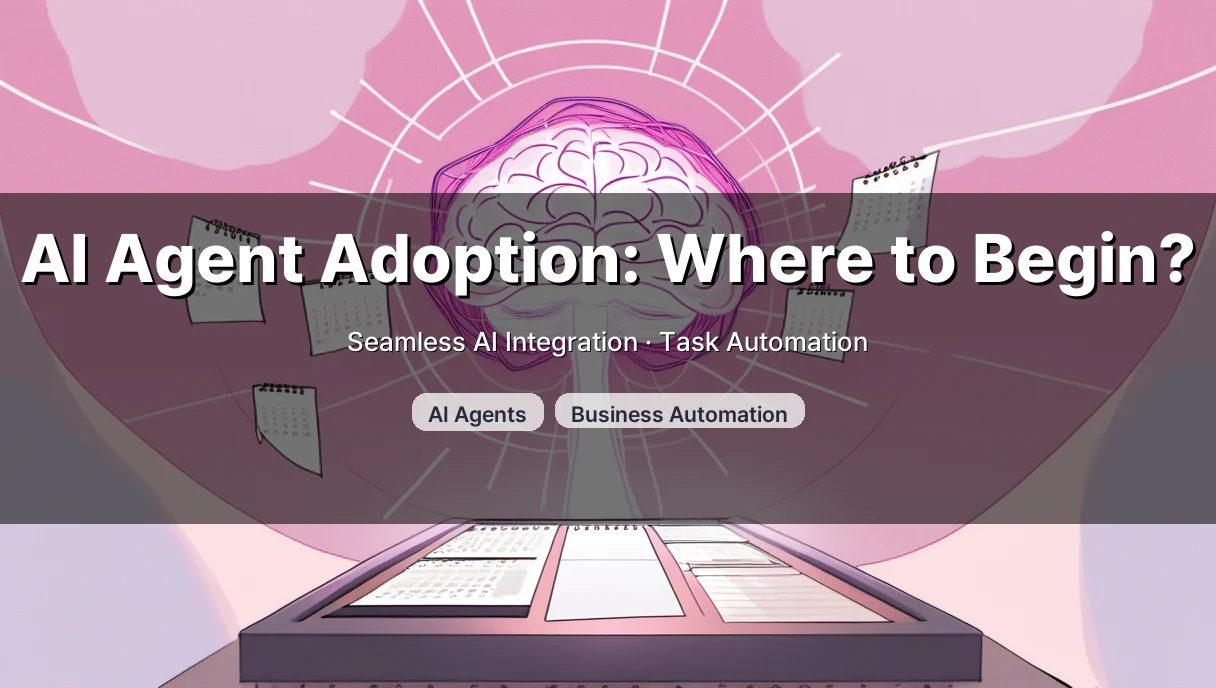
If your team is starting to ask these questions, the signs are already there. 'We've used ChatGPT, so how does this change our work?' The bottleneck isn't the model itself, but the integration. Transitioning to AI agents isn't about just adding another chat window; it's about designing a system that allows AI to fully handle a chunk of repetitive tasks from start to finish, replacing human intervention.
Why Consider AI Agents Now?
Expectations surrounding agent AI have certainly grown. Gartner predicts that by 2028, 15% of daily business decisions will be made autonomously by agent AI, and 33% of enterprise software will incorporate agent AI. At the same time, Gartner also warned that over 40% of agent AI projects could be canceled by the end of 2027.
These two statements must be viewed together. It doesn't mean it's too late; rather, it implies a high probability of failure if applied indiscriminately to any task. What's needed now isn't a company-wide mandate, but an approach that starts with small-scale verification on a single task where impact is evident.
AI Agents Transform Processing, Not Just Answering
Chatbots answer questions. Agents, however, receive a goal and execute the necessary steps to achieve it. For instance, when a customer inquires about delivery, an agent would check the order status, query the delivery system, escalate to a human if an exception occurs, and if not, directly inform the customer.
Therefore, the core of transitioning to AI agents isn't about generating smarter sentences. It's about unifying fragmented tasks, previously pieced together manually, into a single, seamless workflow. Understanding this distinction makes it much clearer where to apply agents first.
It's Better to Start with Just One Task
There's no need to design a grand system from the outset. In fact, properly selecting a single small task is much faster. When framed in practical terms, the AI development process for startups and SMEs, as outlined by YozmIT, generally follows this sequence:
| Stage | Key Task | Practical Point |
|---|---|---|
| 1. Goal Setting | Task Selection | Start with repetitive, clearly defined tasks |
| 2. Data Collection & Refinement | Secure input/output examples | Utilize past conversations, documents, logs |
| 3. Model & Framework Selection | Design LLM + Agent structure | Leverage open-source tools like CrewAI, LangChain |
| 4. Training & Validation | Develop PoC (Proof of Concept) | Test with real-world business data |
| 5. Deployment | Connect to live environment | Pre-check security, access permissions (essential) |
| 6. Operations & Advancement | Performance monitoring + Retraining | Regularly incorporate data changes |
The criteria for choosing your first task are simple: it should be highly repetitive, have clear rules, and be recoverable if errors occur. This is why tasks like customer FAQ responses, drafting weekly reports, ticket classification, or organizing product information are often good starting points.
Commonalities in Public Success Cases
Publicly available cases often show similar areas of early success. HubSpot announced that by May 2025, its Breeze Customer Agent resolved over 50% of support conversations for thousands of clients, with some clients reaching an 80% resolution rate. Gartner also predicts that by 2029, 80% of common customer service issues could be handled without human intervention.
In Korea, the case of 'Enhance' unveiled by AWS Korea is noteworthy. This company pursued the automation of complex commerce tasks using vertical AI agents and was featured in an AWS public session as a success story with KRW 7.2 billion in revenue and 20x growth in 2023. While no single case guarantees a universal answer, it's insightful to note that AI agents quickly demonstrate their power in clearly bounded problems like customer support or specific domain tasks.
CrewAI vs. LangChain: Different Approaches
While both are frequently compared, they originate from different design philosophies. CrewAI excels at rapidly building role-based division of labor and collaborative structures among multiple agents. Its official documentation prominently features collaborative orchestration, focusing on agents, crews, and flows.
LangChain offers a broader scope for tool integration and control. According to its official documentation, agents can select and repeatedly execute tools, making it suitable for integrating control mechanisms like middleware and human-in-the-loop workflows. If existing systems, approval flows, and data integration are critical, LangChain-based solutions might be a more natural fit. However, if the goal is to quickly demonstrate a role-based Proof of Concept, CrewAI offers a more convenient path.
What's important isn't the framework's name. It's distinguishing whether your current task prioritizes validating a collaborative structure or integrating with and controlling internal systems.
Establish These Standards Before Deployment
Minimize Permissions First. AWS Prescriptive Guidance recommends implementing verification and approval workflows before allowing access or modifications to sensitive systems. Granting write permissions to agents from the outset is risky. It's safer to start with read-only access and recommendations, postponing actual changes until after approval.
Manage Both Input and Output Data. Prompts, linked documents, inference results, and execution logs can all become potential leakage paths. Without data classification and access policies in place, deploying agents is more likely to lead to a loss of control than successful automation.
No Monitoring, No Operations. Projects often fail not because the model is unintelligent, but because they are excessively implemented without clear success criteria. You must first define which responses can be automatically approved and which actions absolutely require human review.
Caution: Agent AI is a field with great potential, but also prone to hype. This is why Gartner simultaneously warned about potential project cancellations. The fact that a demo runs well does not automatically prove its operational value.
Conclusion: One Task for This Week
Transitioning to AI agents prioritizes small-scale design over grand declarations. Choose one task within your team that is highly repetitive, has clear rules, and has a low cost of error. Then, outline its input, decision-making, execution, and review processes, line by line.
If, after outlining these steps, the workflow still isn't clear, it's highly likely that this isn't the right task for agent implementation yet. Conversely, if the flow becomes apparent, then design becomes more critical than tools. That's the path to a sustainable AI agent transformation.
Referenced Public Resources
<p>🔗 <a href='https://www.gartner.com/en/newsroom/press-releases/2025-06-25-gartner-predicts-over-40-percent-of-agentic-ai-projects-will-be-canceled-by-end-of-2027' target='_blank' rel='noopener noreferrer'>Gartner: Over 40% of Agentic AI Projects Will Be Canceled by End of 2027</a></p> <p>🔗 <a href='https://www.gartner.com/en/newsroom/press-releases/2025-03-05-gartner-predicts-agentic-ai-will-autonomously-resolve-80-percent-of-common-customer-service-issues-without-human-intervention-by-20290' target='_blank' rel='noopener noreferrer'>Gartner: Agentic AI Will Autonomously Resolve 80% of Common Customer Service Issues by 2029</a></p> <p>🔗 <a href='https://yozm.wishket.com/magazine/detail/3349/' target='_blank' rel='noopener noreferrer'>YozmIT: 6-Step AI Development Process for Startups and SMEs</a></p> <p>🔗 <a href='https://docs.crewai.com/' target='_blank' rel='noopener noreferrer'>CrewAI Official Documentation</a></p> <p>🔗 <a href='https://docs.langchain.com/oss/python/langchain/agents' target='_blank' rel='noopener noreferrer'>LangChain Official Documentation</a></p> <p>🔗 <a href='https://docs.aws.amazon.com/prescriptive-guidance/latest/agentic-ai-security/best-practices-data.html' target='_blank' rel='noopener noreferrer'>AWS Prescriptive Guidance: Agentic AI Security and Data Governance</a></p> <p>🔗 <a href='https://www.hubspot.com/company-news/customer-agent-expansion' target='_blank' rel='noopener noreferrer'>HubSpot: Breeze Customer Agent Public Case Study</a></p> <p>🔗 <a href='https://www.youtube.com/watch?v=aaNmMJEp12s' target='_blank' rel='noopener noreferrer'>AWS Korea: Enhance Vertical AI Agent Public Session</a></p>