Delegating to AI Agents: Your Practical Guide for 2026
Learn how to effectively delegate tasks to AI agents by 2026. This guide covers identifying automatable tasks, structuring workflows, and practical steps for office workers.
Every week, I write reports in the same format, yet I always start from scratch. After every meeting, someone has to write the minutes, and today, that someone was me. If these tasks accumulate for two hours a day, it adds up to three full days a month.
2026 marks a turning point in this trend. SAP predicts that by this year, 40% of all enterprise applications will integrate AI agents. Samsung SDS explains that AI is evolving beyond simple response tools into a collaborative structure that understands goals and executes semi-autonomously, step by step.
What's important isn't flashy features. For today's professionals, the truly essential skill is quickly understanding how much of their work can be delegated and where their judgment is still required.
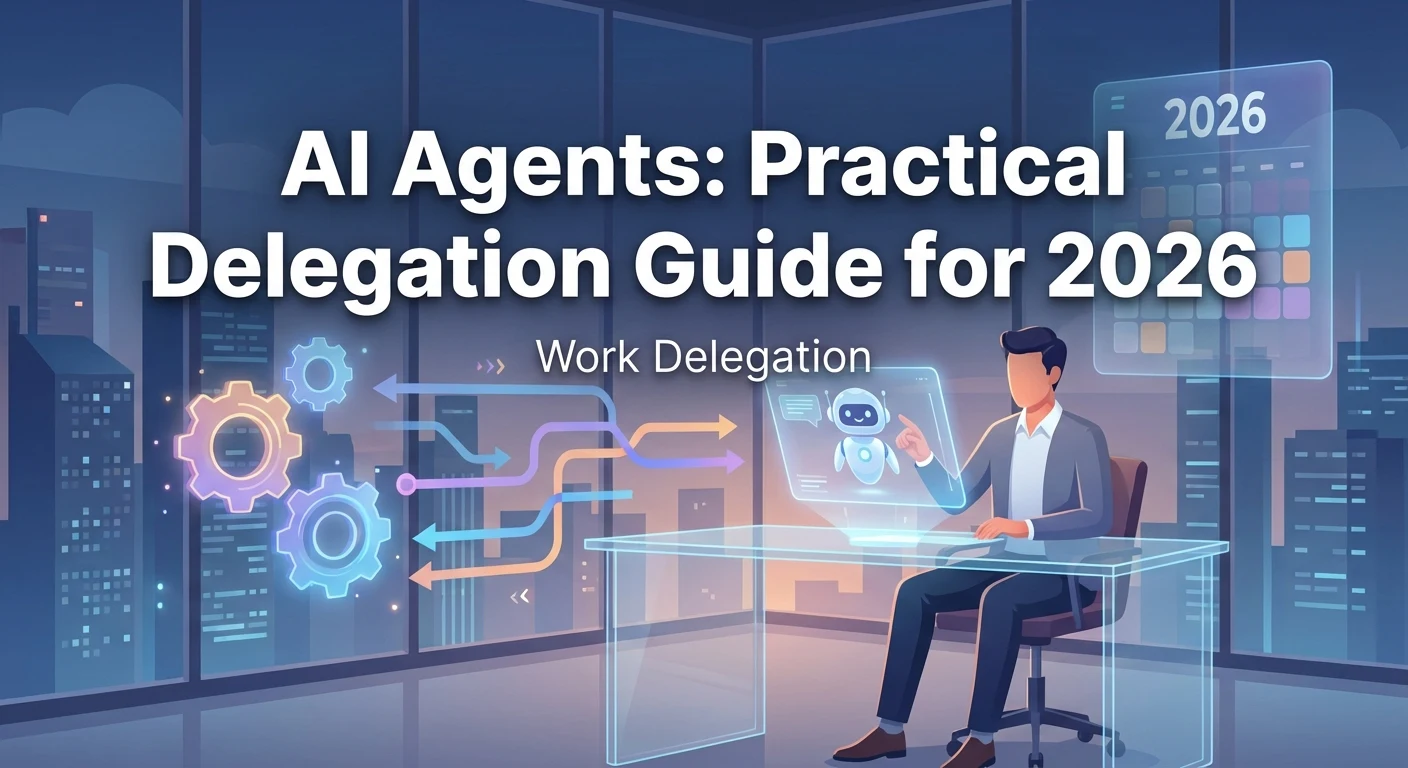
"Breaking Down Tasks Well" Trumps "Smarter AI"
While previous AI excelled at drafting or summarizing, today's AI agents are moving towards handling entire workflows. This involves reading schedules, finding information, compiling results through multiple steps, and then requesting human verification midway.
Samsung SDS's 'Agentic AI' concept aligns with this structure. It's not about replacing humans entirely, but rather providing goals and criteria, allowing the AI to sequence tasks and assist in execution. This shifts the fundamental question for professionals from "Which AI is best?" to "Into what units can I break down my repetitive tasks for delegation?" — a much more practical inquiry.
How Real Companies Are Saving Time
According to a Chosun Ilbo report, Suzano, the world's largest pulp manufacturer, adopted Gemini Pro-based AI agents to convert natural language questions into SQL queries, reducing data query time by 95%. This structure eliminates bottlenecks the moment commonly asked questions are transformed into tasks that the system can process.
Danish industrial company Danfoss applied AI agents to email order processing, automating 80% of transactional decisions and reducing customer response times from an average of 42 hours to near real-time. The common thread in both cases isn't "What is AI good at?" but rather "How quickly were repetitive, rule-based tasks structured for automation?"
Domestically, LS Electric integrated an AI assistant into its PLC (Programmable Logic Controller) work environment, lowering the barrier to entry so that tasks previously handled quickly only by skilled experts could be performed stably by more personnel (Maeil Business Newspaper report). Regardless of size or industry, if a task is repetitive and rule-based, there's an opportunity for AI intervention.
The First Tasks You Should Automate
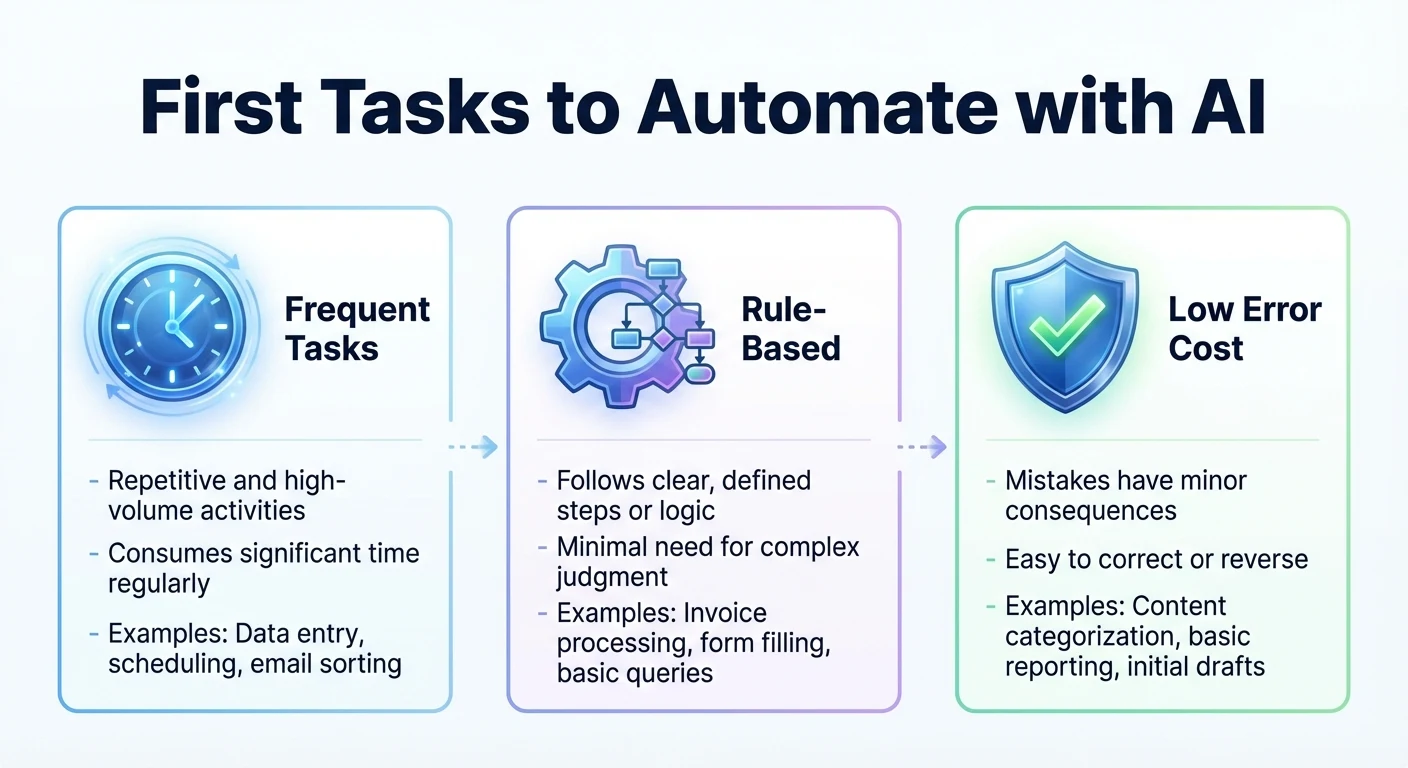
Attempting to connect every task to an AI agent from the outset almost always leads to failure. The key is to start not with "time-consuming tasks," but with tasks that are frequent, rule-based, and have a low cost of error. This includes drafting repetitive emails, summarizing meeting minutes and extracting follow-up actions, gathering information from multiple documents for summarization, and creating drafts of reports in a defined format.
Conversely, tasks involving complex contextual judgment, such as performance reviews, final budget approvals, or sensitive customer communications, are difficult to delegate from the start. AI excels at structured tasks, not those requiring complex judgment.
Once the scope is defined, the next step is the actual implementation sequence.
A Realistic AI Workflow Implementation Sequence
Instead of aiming for an elaborate system, the starting point is to break down your tasks into three stages: Input, Process, and Review. Taking meeting follow-up as an example: Input would be recordings or notes; Process would be summarizing and organizing action items; and Review would be confirming priorities and deciding whether to send it out. Dividing tasks this way immediately reveals how much can be automated.
1. Choose Just One Repetitive Task Start with a single task that repeats at least three times a week. A narrow scope makes it easier to measure the impact.
2. Define the Output Format for the AI First Instead of 'Summarize this well,' a prompt like 'Provide a 3-line summary, action items by owner, and deadlines only' will yield much more stable results. The structure of your instructions influences the quality of the output more than the AI's raw performance.
3. Always Include a Human Review Point Pre-sending checks, numerical verification, and external document approvals must be handled by a human. Even Samsung SDS's Agentic AI concept is predicated on "semi-autonomous execution under human supervision."
4. Check the Impact on a Weekly Basis Attempting to calculate a large, immediate ROI will lead to roadblocks. Considering that even companies struggle with measuring AI agent performance, for individuals, it's more realistic to start by observing 'how many minutes were saved this week' or 'if rework decreased.'
As you repeat these steps, the next question will naturally arise: Where should you stop?
What Lies Behind the Convenience
As AI adoption increases, so does anxiety, for clear reasons. Concerns about job displacement due to automation, a lack of transparency in employer plans, and ambiguity in security and accountability structures are all frequently cited. The fact that 51% of customer service leaders have delayed or limited AI adoption due to security concerns further underscores that standards should precede speed.
Caution: For sensitive information like customer data, HR data, or contract documents, separate guidelines must be established before inputting them into AI. Caution: Treat AI-generated results as "drafts," and it's fundamental to conduct fact-checking and responsible party review before external distribution.
Simply pasting any document and skipping any approval process just because it's convenient will only accumulate risks.
The Ability to Delegate Well is the Next Core Skill
Analysis suggests that the role of employees is shifting from direct execution to becoming 'human orchestrators' who manage and direct AI agents. In practical terms, it's simple: you don't have to do everything yourself, but you must have a clearer understanding of what to delegate and what to verify.
According to SK C&C, the AI agent market is projected to grow from $7.55 billion in 2024 to $199.05 billion by 2034. This isn't just a trend; it's a signal that work methods are genuinely changing.
The crucial first step needed now is this: Jot down one task you've repeated three or more times this week, divide it into Input-Process-Review, and then try delegating just the 'Process' stage to AI first. As these experiences accumulate, AI will transform from a vague topic into a practical tool that truly gives you back your time.