AI-RAN: How Korea's Telcos Are Integrating AI into Networks
Experiencing slow data in crowded places? Learn how AI-RAN is transforming wireless networks, with Korean telcos leading the charge to integrate AI for better performance and new services.
It's not uncommon to experience video buffering on a crowded subway commute or painfully slow data near a concert venue. While we all want faster networks, speed alone doesn't solve these issues. Even the fastest 5G can struggle with congestion if base stations can't intelligently allocate resources in densely populated areas.
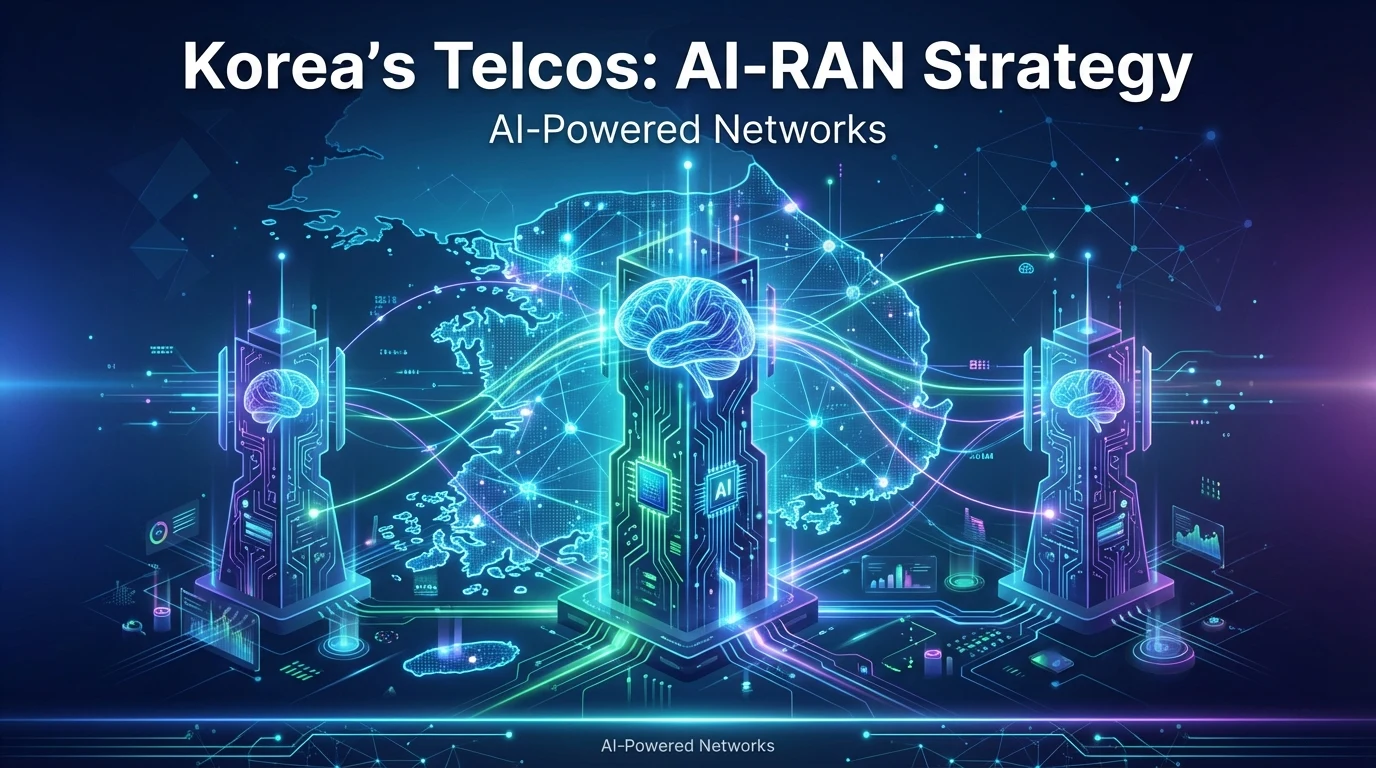
This is precisely what `AI-RAN` aims to change. AI-RAN integrates artificial intelligence into the Radio Access Network (RAN) to predict traffic, automatically allocate resources, and react more quickly to network failures. All three major South Korean telecommunication companies are now actively pursuing this technology.
How AI-RAN Differs from Existing Networks
Existing wireless networks are already incredibly complex. Optimizing for time-of-day traffic fluctuations, localized congestion, fault recovery, and power efficiency manually has its limits. AI-RAN addresses this by deploying AI and GPU-equipped base stations.
According to Computerworld, the core isn't just simple automation. The goal is to simultaneously process both communication services and AI services within a single base station. This transforms signal-transmitting equipment into a computational platform that can interpret situations and make decisions.
When 6G becomes mainstream, the number of connected devices and the demand for real-time processing will far exceed current levels. While AI-RAN is a foundation for that future, to be frank, it's also a practical necessity for maintaining the current network effectively.
The Three Layers of AI-RAN: Operations, Services, and Integration
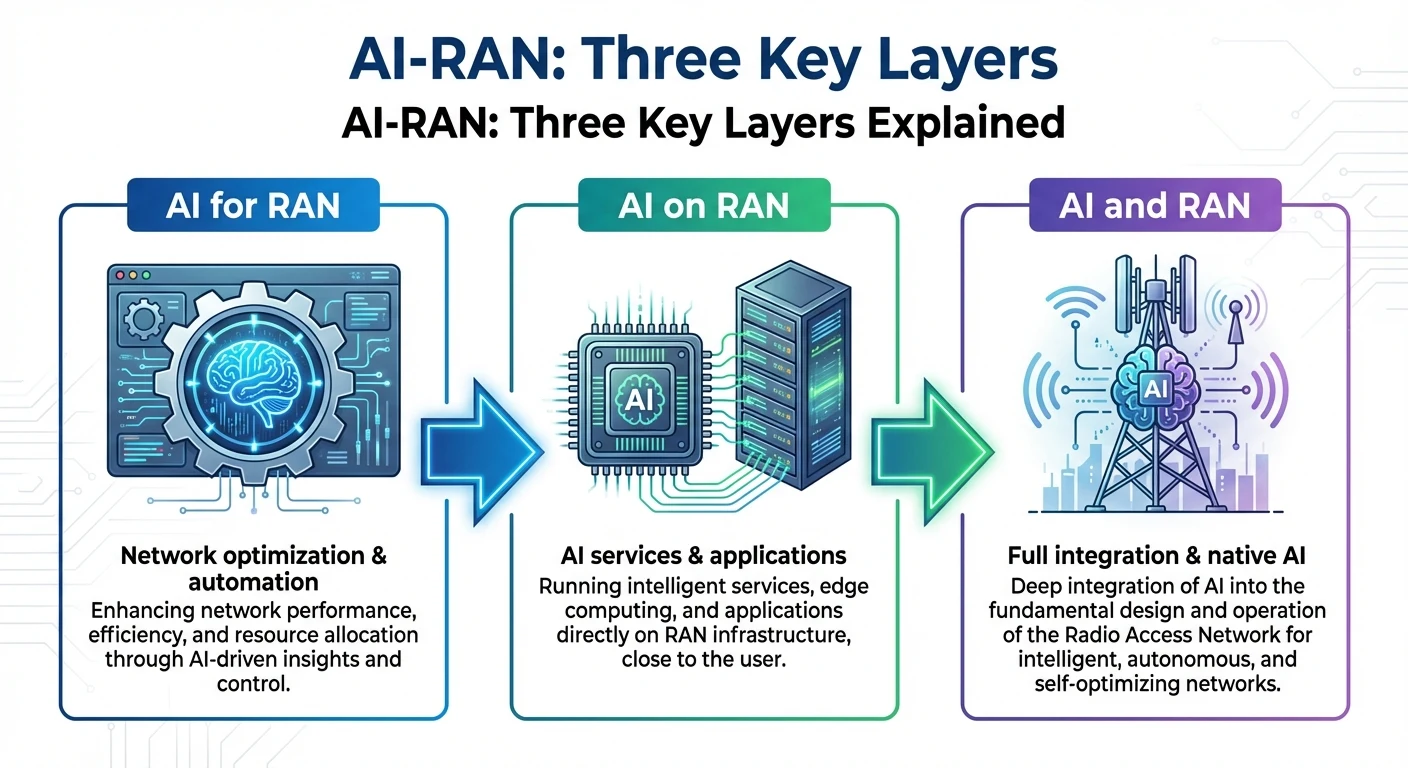
The AI-RAN Alliance explains this trend through three distinct concepts.
AI for RAN — This involves using AI to improve the operation of the wireless network itself. Traffic prediction, automated resource allocation, and accelerated fault recovery fall into this category. It's the area where telecommunication companies can experiment most rapidly right now.
AI on RAN — This focuses on directly running AI services on base stations and edge infrastructure. Communication equipment becomes an AI computing hub, which is advantageous for latency-sensitive services. Computerworld's description of "simultaneously providing communication and AI services on a single piece of equipment" aligns with this concept.
AI and RAN — This is a broader framework that integrates both concepts. It envisions a structure where network operations are advanced by AI, and that same network simultaneously serves as the execution platform for AI services.
Considering these three layers, it's clear that AI-RAN is not merely an optimization feature but an attempt to expand the very role of telecommunication networks.
Where Do Korea's Top 3 Telcos Stand?
SK Telecom, KT, and LG Uplus are all participating in the AI-RAN Alliance. According to The Elec, this alliance was launched in late February 2024 by 11 global tech giants, including Samsung Electronics, and has since expanded to 132 member companies as of March 2026.
At the policy level, all three telcos are jointly participating in a 45 billion won (approximately $33 million USD) 'AI-RAN Global Leading Project' consortium led by the Ministry of Science and ICT (MSIT) (ETNews). This indicates a strategic direction to align with national projects and global standardization efforts, rather than pursuing individual initiatives.
SK Telecom is showing the most concrete progress. In December 2025, it became the first Korean telco to join the AI-RAN Alliance board (Seoul Economic Daily). In November of the same year, it signed an MOU with Samsung Electronics for joint development of core 6G technologies. In February 2026, SK Telecom announced that it had successfully validated NVIDIA GPU-based AI-RAN equipment in a trial network, in collaboration with Nokia, HFR, and Intel.
While KT and LG Uplus's participation is confirmed, their specific roles within the alliance are not yet definitively clear from publicly available information. LG Uplus is primarily known for its focus on Cloud RAN and the advancement of autonomous networks. More detailed distinctions are expected to emerge as proof-of-concept results are released.
What Will Actually Change?
The most immediate benefit we can expect is enhanced quality stability during congestion. By predicting when and where people gather, base stations can more flexibly allocate resources, leading to a noticeable improvement in perceived quality even with the same underlying infrastructure.
Secondly, the telecommunication network itself will become an execution environment for AI services. If AI on RAN becomes a reality, latency-sensitive services can be processed closer to the base station, rather than requiring round trips to the cloud.
Note: Sufficient quantitative data is still lacking. It's important to be cautious about claiming "definite improvements" until more real-world validation cases accumulate. This is a period where verification is more crucial than expectation.
Remaining Challenges
For AI-RAN to function effectively, common standards must first be established. If base stations are built using incompatible methods, it will not only reduce investment efficiency but also complicate service integration.
There's also the issue of leadership. If Korean companies merely participate in alliances led by U.S. tech giants like NVIDIA and Qualcomm, they might end up as mere adopters of standards. Standards gain strength not from announcements but from validated data and operational experience. The true competitive edge will come from accumulating a significant number of verified results.
As networks become more intelligent, security and privacy issues will also grow more complex. Public discussion on these aspects is still insufficient, so this area requires careful monitoring going forward.
Conclusion
The AI-RAN alliances and the initiatives by Korea's three major telcos are less about 6G marketing slogans and more about real, ongoing changes to telecommunication networks. The direction where base stations embrace AI and networks become service execution platforms has already begun.
However, depth is more critical than direction at this stage. Future proof-of-concept results and contributions to standardization will determine the true impact of this trend. For anyone following this topic, there's one key criterion: It's not about who spoke first, but who proved it first on a live network.