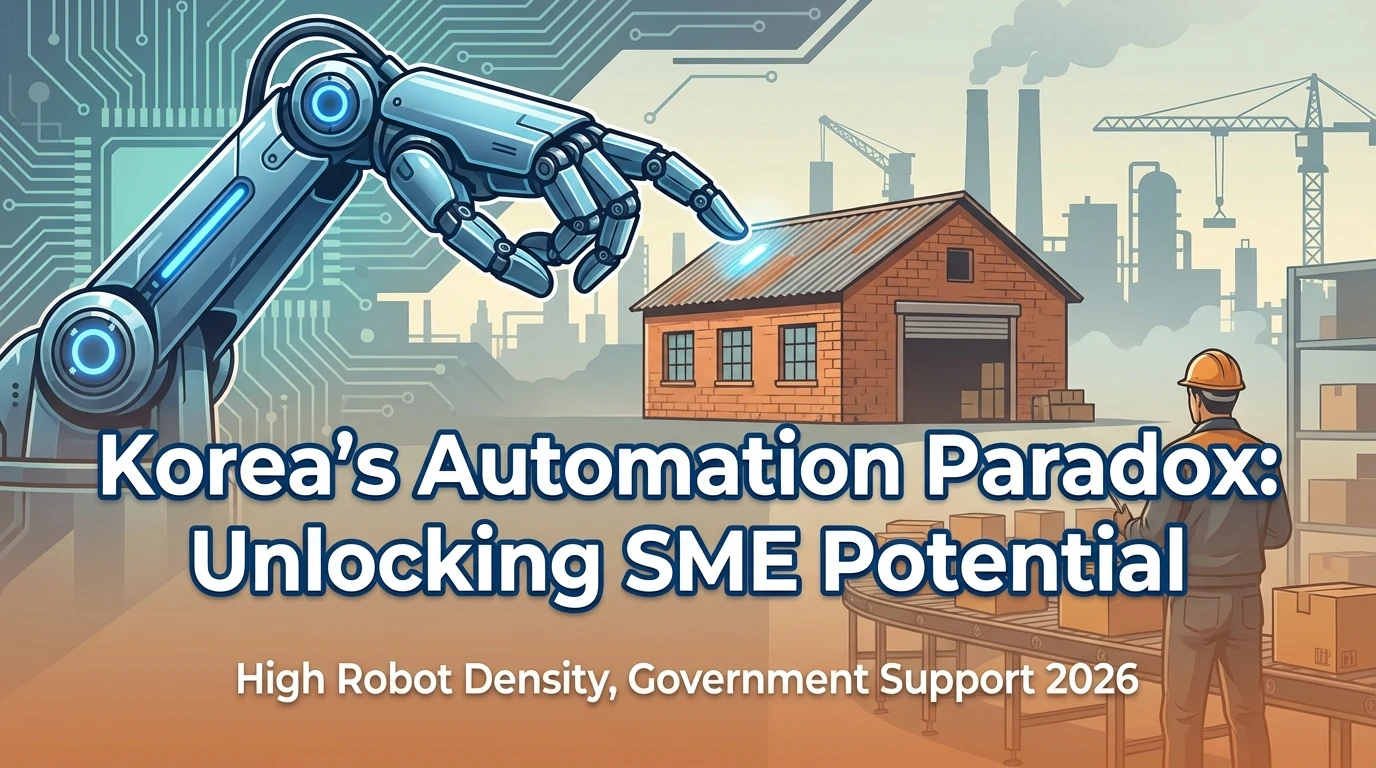
Korea's Automation Paradox: Why Factories Lag
Despite Korea leading in manufacturing robot density, many factories struggle with automation. Discover why now is the right time for SMEs to automate, how to identify bottlenecks, and leverage govern
According to the latest report from the International Federation of Robotics (IFR), South Korea boasts the world's highest manufacturing robot density, with 1,012 robots per 10,000 workers. This is more than six times the global average of 162 robots. This suggests that the foundation for automation is already well-established. So why do many of our factories still heavily rely on manual processes?
There are days when finding skilled labor is difficult, deadlines are tight, and a single defect can derail an entire day's production plan. While the need for automation is clear, the immediate question for many is, "Can small and medium-sized enterprises (SMEs) truly start now?" In 2026, the answer to that question is changing.
Why Now is the Right Time for SME Automation
In October 2025, Korea's Ministry of SMEs and Startups and the Smart Manufacturing Innovation Promotion Group announced an integrated call for proposals for the 2026 Intelligent Manufacturing Innovation Support Project. With a total budget of approximately 500 billion Korean Won (around $370 million USD), AI-related support has been significantly expanded. The program aims to support about 450 projects, including 30 autonomous factories, 400 AI-specialized smart factories, and 20 large-small enterprise collaborative AI tracks, with companies eligible to receive up to 400 million Korean Won (around $300,000 USD) each.
Samsung Electronics has been supporting the establishment of smart factories for SMEs for 10 years since 2015. In May 2023, it transitioned to 'Smart Factory 3.0,' an AI and data-driven approach. According to Samsung's announcement, metal processing companies that received support achieved a 20% reduction in defect rates, a 30% increase in productivity, and a 15% rise in sales. Food and beverage companies, after adopting robots, saw a 25% improvement in shipping speed and a 40% increase in per-person productivity. While these are cases supported by a large corporation, they clearly demonstrate that "SMEs can achieve this too."
What to Look for Before Robots: Bottlenecks
The most common mistake when considering automation is to start by selecting equipment. If only one process speeds up, but the cycle times of the preceding and succeeding processes don't match, bottlenecks can actually become more pronounced. This creates the paradox where automation, instead of increasing productivity, lengthens waiting times.
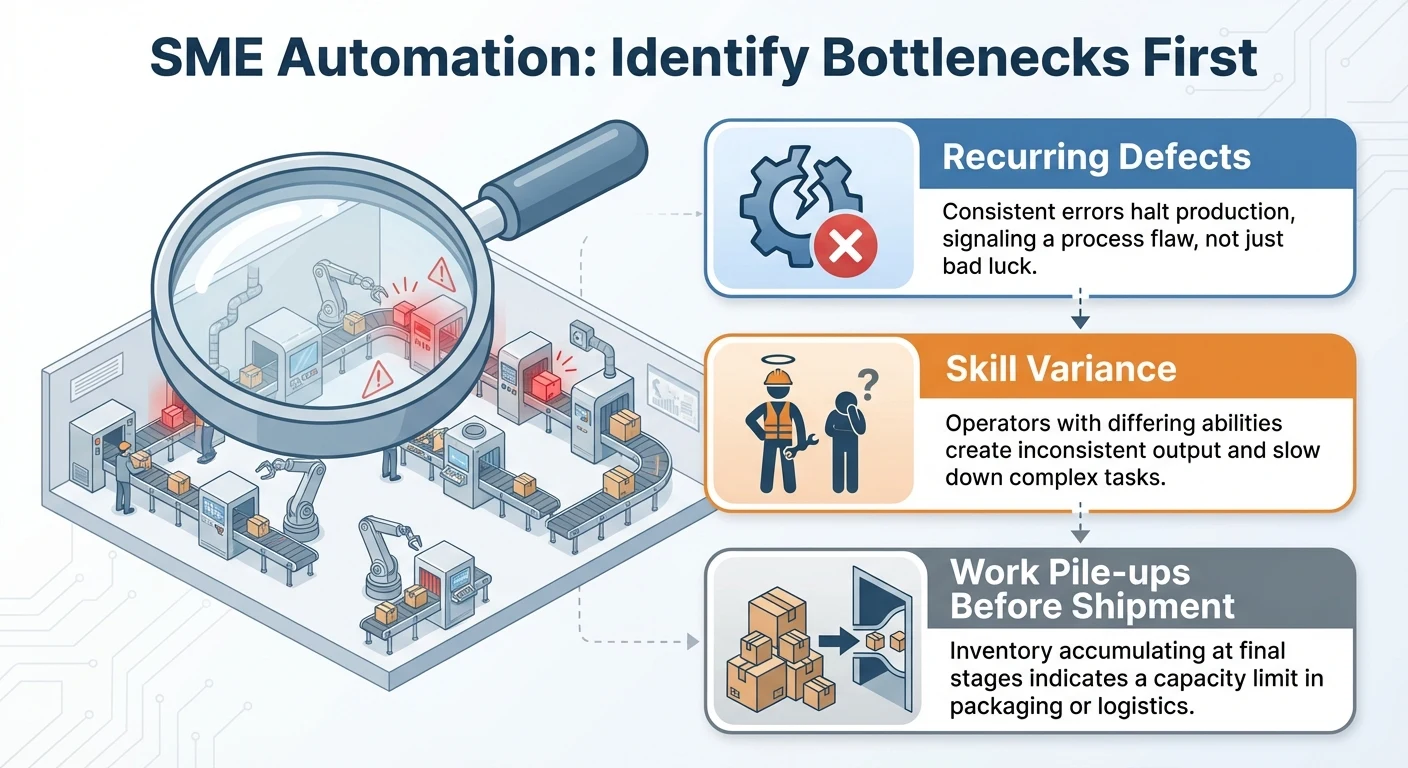
The starting point shouldn't be "What should we buy?" but "Where do we consistently get stuck?" You should first identify areas with recurring defects, processes where results vary significantly depending on worker skill level, and sections where work piles up just before shipment. The Samsung support cases were able to show their effects in numbers precisely because they first identified on-site problems before introducing technology.
Navigating the 2026 Government Support Programs
Government calls for proposals are designed with a phased entry approach. Aiming for full-scale automation from the outset can lead to excessive burden. Starting with a single step, such as data collection for a specific process and automating decision-making, makes it easier to meet the eligibility requirements for support programs.
Note: While some content may refer to the 'K-Smart Manufacturing 2.0 Roadmap,' the official government designations are the 'AI-based Intelligent Manufacturing Innovation 3.0 Strategy' and the 2026 Integrated Call for Proposals. Always refer to the original announcement before applying.
Five Things to Check Before Automation
These are points to examine on-site before deciding on equipment. If any of these are unclear, process streamlining should precede automation.
- Recurring Defect Processes: Are defects, idle times, or reworks concentrated in specific areas?
- Skill Variation: Do production volume or quality vary significantly among workers?
- Data Collection Environment: Is there a minimum setup for collecting sensor or equipment data?
- Upstream/Downstream Process Adjustment: Is there capacity to adjust preceding and succeeding processes after automation?
- Workforce Transition Plan: Can retraining and role changes for operating personnel be planned concurrently?
The Next Competitive Edge Lies in Field Data
According to ETNews, the Korean government defines 'Physical AI' – which goes beyond simple automation to self-assess and act – as a national strategy. The core isn't about glamorous future technology, but about capturing the experience and judgment of skilled manufacturing workers as data.
If processes traditionally run by a skilled worker's intuition aren't structured into data, even after robots are introduced, the factory will ultimately still depend on one or two people. Conversely, if data begins to accumulate for even a small process, automation then becomes a competitive advantage, not just equipment.
For the phrase "manufacturing automation powerhouse" to truly connect with our factories, we must first identify the process that most frequently causes disruption. Government support has undoubtedly expanded, and automation infrastructure is sufficient. Success ultimately depends on accurately pinpointing bottlenecks and being prepared to transform both people and processes.