Hotteok Guide: Korea's Sweet Street Pancake, Explained
You're walking through a Korean market on a cold afternoon, and a vendor is pressing golden dough flat on a sizzling griddle. The smell — brown sugar, cinnamon, roasted peanuts — stops you mid-step. That's hotteok (호떡), and figuring out what to order, where to find the best ones, and how the different types compare is less straightforward than it looks.
This article covers what hotteok actually is, the main varieties you'll encounter across Korea, where travelers consistently find the best versions, and how to make a solid one at home if you want to try.
What Hotteok Is — And What It Isn't
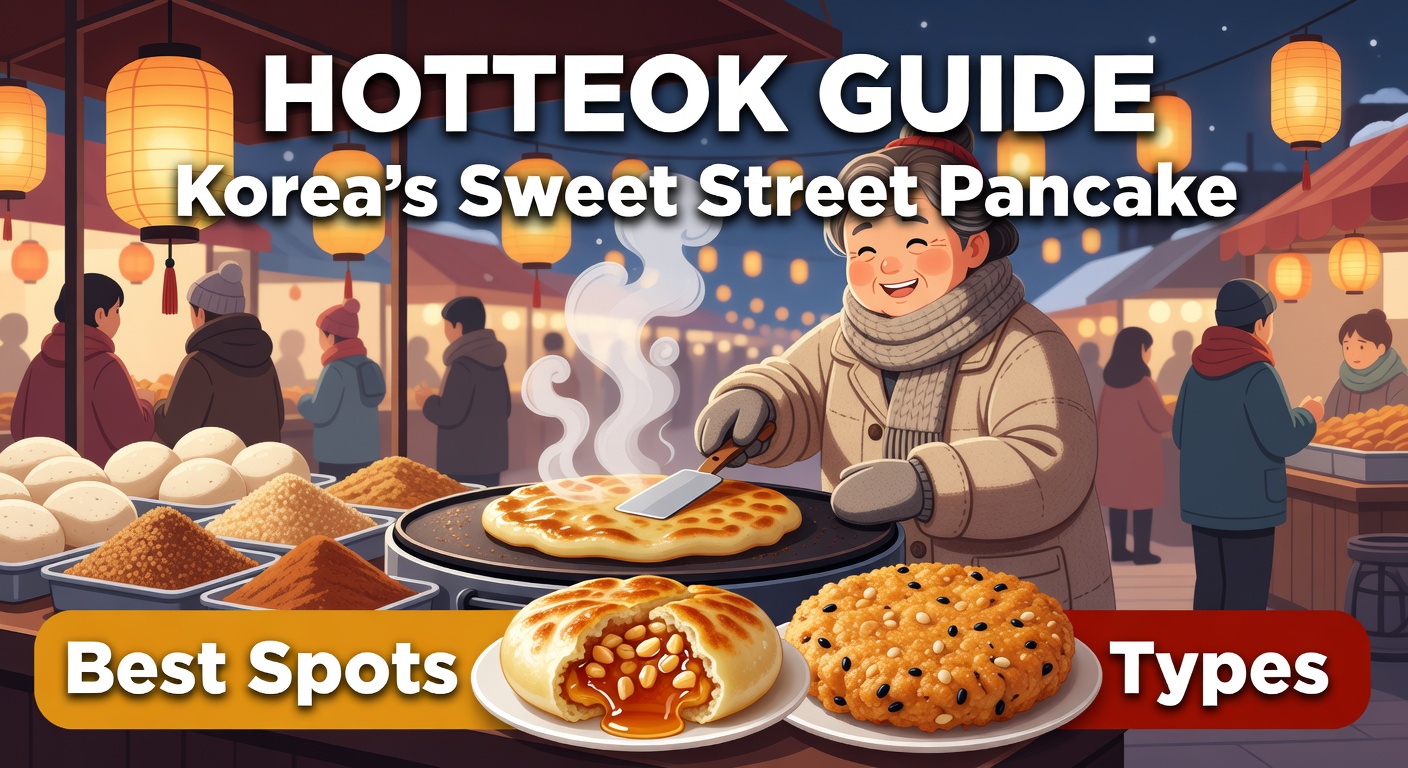
Many people assume hotteok is a traditional Korean food with ancient roots. The reality is more interesting. According to the Encyclopedia of Korean Culture, hotteok traces back to Chinese merchants (화교, hwagyo) who brought a filled pancake called hobyeong (胡餠) to the Korean peninsula in the 1880s. By 1930, there were roughly 1,139 hotteok shops spread across major Korean cities — a remarkable number that shows how quickly Koreans adopted the snack as their own.
What makes hotteok distinct from its Chinese ancestor is the Korean adaptation: a dough made from wheat flour and glutinous rice flour (찹쌀가루), stuffed with a filling of brown sugar, cinnamon, and crushed peanuts, then pressed flat and pan-fried in oil. The glutinous rice flour is the key. It gives the inside that signature chewy, slightly stretchy texture that regular wheat pancakes never achieve. The outside crisps up golden, while the filling melts into a molten syrup.
🔗 Encyclopedia of Korean Culture — Hotteok Entry
One thing that trips people up: hotteok is not the same as hoddeok-ppang (호떡빵) or hotcake. Street vendors sometimes use these terms loosely, but classic hotteok is always a filled, pressed pancake — not a fluffy cake or a plain fried bread. If you see a round, flat disc being pressed with a metal spatula on a griddle, that's the real thing.
The calorie count sits at roughly 230 kcal per piece, though this varies depending on how much oil the vendor uses and how generous the filling is. It's a snack, not a meal replacement — but after walking through a winter market, one or two feels like exactly the right amount.
Hotteok Varieties: What to Expect Across Korea
The classic brown sugar hotteok is what most visitors encounter first, but Korea has developed a surprisingly wide range of regional and modern variations. Here's where people commonly get confused: they try one type, assume they've experienced hotteok, and miss the versions that might suit their taste better.
Ssiat hotteok (씨앗호떡) is the version many repeat visitors end up preferring over the classic. Originating from Busan's BIFF Square area, it replaces the standard filling with a mix of sunflower seeds, pumpkin seeds, and other toasted seeds bound with brown sugar. The texture is crunchier and nuttier, and many travelers end up preferring it to the original. If you visit Busan and skip ssiat hotteok, you've missed the city's signature street food contribution.
Vegetable hotteok (야채호떡) swaps the sweet filling for a savory mix of glass noodles (japchae-style), carrots, onions, and sometimes kimchi. This version is more common in certain Seoul neighborhoods and appeals to people who find the sugar version too sweet. It's a completely different eating experience — closer to a savory stuffed pancake than a dessert.
More recent additions include chocolate hotteok, green tea hotteok, and injeolmi hotteok (coated in roasted soybean powder after cooking). These are more common at trendy food stalls and franchise shops than at traditional street carts.
| Variety | Filling | Texture | Best for |
|---|---|---|---|
| Classic (설탕) | Brown sugar, cinnamon, peanuts | Chewy inside, crispy outside | First-timers, sweet tooth |
| Ssiat (씨앗) | Mixed seeds, brown sugar | Crunchy, nutty | Busan visitors, nut lovers |
| Vegetable (야채) | Glass noodles, vegetables | Savory, substantial | Savory preference, meal substitute |
| Chocolate (초코) | Chocolate, sometimes with nuts | Rich, gooey | Kids, dessert lovers |
| Injeolmi (인절미) | Brown sugar + soybean powder coating | Extra chewy, powdery finish | Tteok (rice cake) fans |
The seed and vegetable versions tend to be slightly more expensive — typically ₩2,000–3,000 versus ₩1,000–1,500 for classic — but they're also larger and more filling.
Where to Find Hotteok: Seoul, Busan, and Beyond
Hotteok is technically available everywhere in Korea during the colder months, but not all hotteok is created equal. Based on consistent traveler reviews and food coverage, a few areas stand out.
In Seoul, Namdaemun Market remains one of the most reliable spots. The vendors there have been making hotteok for decades, and the turnover is fast — meaning your hotteok is always freshly made, not sitting in a warming tray. Myeongdong also has several stalls, though they tend to be more tourist-oriented with slightly higher prices. Gwangjang Market is another strong option, especially if you're already there for bindaetteok (mung bean pancakes) and want to add hotteok to the tasting circuit.
In Busan, BIFF Square in Nampo-dong is the epicenter of ssiat hotteok. The lines can stretch 20–30 people deep on weekends, but they move quickly. The stalls near Jagalchi Market also serve excellent versions, often with a view of the harbor area.
One common mistake: looking for hotteok in summer. Street vendors largely disappear between May and September because hotteok is fundamentally a cold-weather food. Some permanent shops serve it year-round, but the classic street cart experience is a late October through March affair. If you're visiting Korea in July expecting street hotteok, you'll be disappointed. Market stall hours and exact locations also shift between seasons, so a quick confirmation before making a special trip is worth it.
How to Eat Hotteok Without Burning Yourself
This sounds like a joke, but it's the single most common complaint from first-time hotteok eaters. The molten brown sugar filling reaches extremely high temperatures, and the outside cools much faster than the inside. Every year, reviews and travel forums fill up with variations of "I burned the roof of my mouth on hotteok."
The vendor will hand you the hotteok in a paper cup or wrapper. Wait at least 60–90 seconds before biting in. Many experienced locals tear or cut a small opening first to let steam escape, then nibble from the edge inward. The filling stays dangerously hot for longer than you'd expect — the sugar essentially becomes liquid candy.
One more thing worth knowing: thickness varies significantly by vendor. Some press it almost crepe-thin; others leave it thick and puffy. The thin version crisps more evenly and cools faster. The thick version stays chewier and holds more filling. Neither is wrong — it's entirely personal preference.
If you have a nut allergy, this is critical: classic hotteok almost always contains peanuts or mixed nuts in the filling. Always ask "ttangkong isseoyo?" (땅콩 있어요? — "does it have peanuts?") before ordering. The vegetable version is typically nut-free, but confirm with the vendor. Allergy labeling at street stalls is inconsistent, so asking directly is the safest approach.
Making Hotteok at Home: The Practical Version
You don't need to be in Korea to eat hotteok. Hotteok mix (호떡 믹스) is available at most Korean grocery stores worldwide — CJ, Ottogi, and several other brands make reliable versions. The mix simplifies the process significantly because the flour ratio and yeast are pre-measured.
Here's what the process actually looks like:
Dough: Mix the hotteok powder with warm water (follow the package — usually around 160–180ml per packet). Knead until smooth, then let it rise in a warm spot for 30 minutes to 1 hour. The dough should roughly double in size. If you're working from scratch without a mix, combine 2 cups all-purpose flour, ½ cup glutinous rice flour, 1 teaspoon instant yeast, 1 tablespoon sugar, ½ teaspoon salt, and about ¾ cup warm water.
Filling: The included sugar-cinnamon packet works fine, but if making your own, mix brown sugar, a generous pinch of cinnamon, and chopped peanuts or walnuts. About 1 tablespoon of filling per hotteok is the right amount — and this is where most home cooks go wrong. Overstuffing is the number one reason hotteok burst open during cooking.
Forming and cooking: Oil your hands (important — the dough is sticky), take a golf-ball-sized piece, flatten it into a disc, place the filling in the center, and pinch the edges closed tightly. Heat a non-stick pan or cast iron skillet on medium with about 1 tablespoon of vegetable oil. Place the sealed dough ball seam-side down and press flat with a spatula. Cook for 2–3 minutes per side until golden brown.
The key mistake people make at home: using too much heat. High heat burns the outside before the filling melts properly. Medium heat, patience, and steady pressure with the spatula produce the best results.
Frozen pre-made hotteok from Korean supermarkets is another option. Cook these directly from frozen in a lightly oiled pan on medium heat — do not microwave them, as the outside turns soft and rubbery instead of crispy. This is a consistent complaint in product reviews, and the manufacturers themselves recommend pan-frying.
Hotteok vs. Other Korean Street Snacks
If you're building a Korean street food tasting plan, hotteok fits into a specific niche: it's the warm, sweet, handheld dessert option. Here's how it compares to the other snacks you'll see at the same markets.
Bungeoppang (붕어빵, fish-shaped pastry) is the other major winter sweet street food. It uses a waffle-iron-like mold to create a fish shape filled with sweet red bean paste. The texture is completely different — more like a light waffle than a chewy pancake. Bungeoppang is less calorie-dense and less rich than hotteok, making it a better option if you want something sweet but lighter.
Tteokbokki (떡볶이, spicy rice cakes) occupies the savory-spicy lane. Many people combine hotteok and tteokbokki as a classic street food pairing — the sweetness of hotteok balances the heat of tteokbokki nicely. A common street food tour strategy is to eat tteokbokki first, then finish with hotteok as dessert.
Hodugwaja (호두과자, walnut-shaped pastry) is another sweet option, but it's a smaller, bite-sized snack filled with red bean and walnut. It doesn't have the same molten, gooey filling experience that makes hotteok distinctive.
For travelers trying to decide what to prioritize, the honest answer is: try hotteok first if you've never had it, because the texture combination (crispy-chewy with molten filling) doesn't have a close equivalent in most Western food traditions. It's the most uniquely Korean eating experience on the street food spectrum.
The Mukbang Connection and Why Hotteok Keeps Trending
If you've watched Korean food content on YouTube or TikTok, you've probably seen hotteok featured in mukbang (먹방) videos — those close-up eating broadcasts where the sound and visual of food is the main attraction. Hotteok is practically made for this format: the press-and-sizzle on the griddle, the crack of biting through the crust, the pull of the melted sugar.
This media exposure has pushed hotteok from a domestic winter staple into an internationally recognized K-food item. Korean food export data shows that frozen hotteok and hotteok mix products have been expanding into Japanese and Southeast Asian markets, often branded under the broader K-street food category alongside corn dogs and tteokbokki.
For visitors, this means hotteok is easier to find outside Korea than ever before — but the street vendor experience in a cold Korean market remains something that packaged products can't fully replicate. The combination of the cold air, the hot griddle, and eating it fresh out of the paper cup is half the appeal.
Summary: What to Order, Where, and When
Frequently Asked Questions
Q. What does hotteok taste like?
Hotteok tastes like a cross between a cinnamon-sugar donut and a chewy pancake. The outside is crispy and slightly oily from the griddle, while the inside has a stretchy, mochi-like texture filled with melted brown sugar and cinnamon. The filling is intensely sweet, which is why most people eat just one or two at a time.
Q. Where can I buy hotteok in Seoul?
Namdaemun Market and Gwangjang Market are the most reliable spots for street hotteok in Seoul. Myeongdong also has multiple vendors, though prices there tend to be slightly higher. During winter months (November–March), you'll also find carts near major subway exits in busy commercial areas like Hongdae and Sinchon.
Q. Is hotteok available in summer in Korea?
Most street vendors stop selling hotteok between May and September because it's considered a cold-weather food. Some permanent shops and franchise stores offer it year-round, but the classic street cart experience is seasonal. If you're visiting Korea in summer, you'll need to look for dedicated hotteok shops rather than street stalls.
Q. Can I make hotteok without a mix at home?
Yes. Combine 2 cups all-purpose flour, ½ cup glutinous rice flour (this is essential for the chewy texture), 1 teaspoon instant yeast, 1 tablespoon sugar, ½ teaspoon salt, and about ¾ cup warm water. Let the dough rise for 30–60 minutes before filling and cooking. The key is using glutinous rice flour — without it, the texture won't be right.
Q. Is hotteok safe for people with nut allergies?
Classic hotteok almost always contains peanuts or mixed nuts in the filling, making it unsafe for people with nut allergies. The vegetable (야채) version is typically nut-free, but you should always confirm directly with the vendor since recipes vary. Frozen products from Korean supermarkets have ingredient labels you can check in advance — look for 땅콩 (peanut) or 견과류 (nuts) on the packaging.

Korea Travel Guide Creator
Practical Korea travel, food, and culture guides for foreign visitors.
View all posts →