K-Pop Nostalgia Explained — Why 2016 Is Trending Again in Korea
You are scrolling through TikTok in Seoul, and suddenly a Big Bang track from 2012 hits your feed. The comments are flooded with crying emojis from people in their twenties and thirties. Walk into a Hongdae vintage shop and you will find old-era K-Pop concert merch selling for more than it cost a decade ago. If you have noticed Korea's obsession with looking backward while racing forward, you are not imagining things.
This article breaks down why K-Pop nostalgia is one of Korea's strongest cultural currents in 2026, what is actually driving it, how it shows up in fashion, streaming, and resale markets, and where you can experience it firsthand if you are visiting or living in Korea right now.
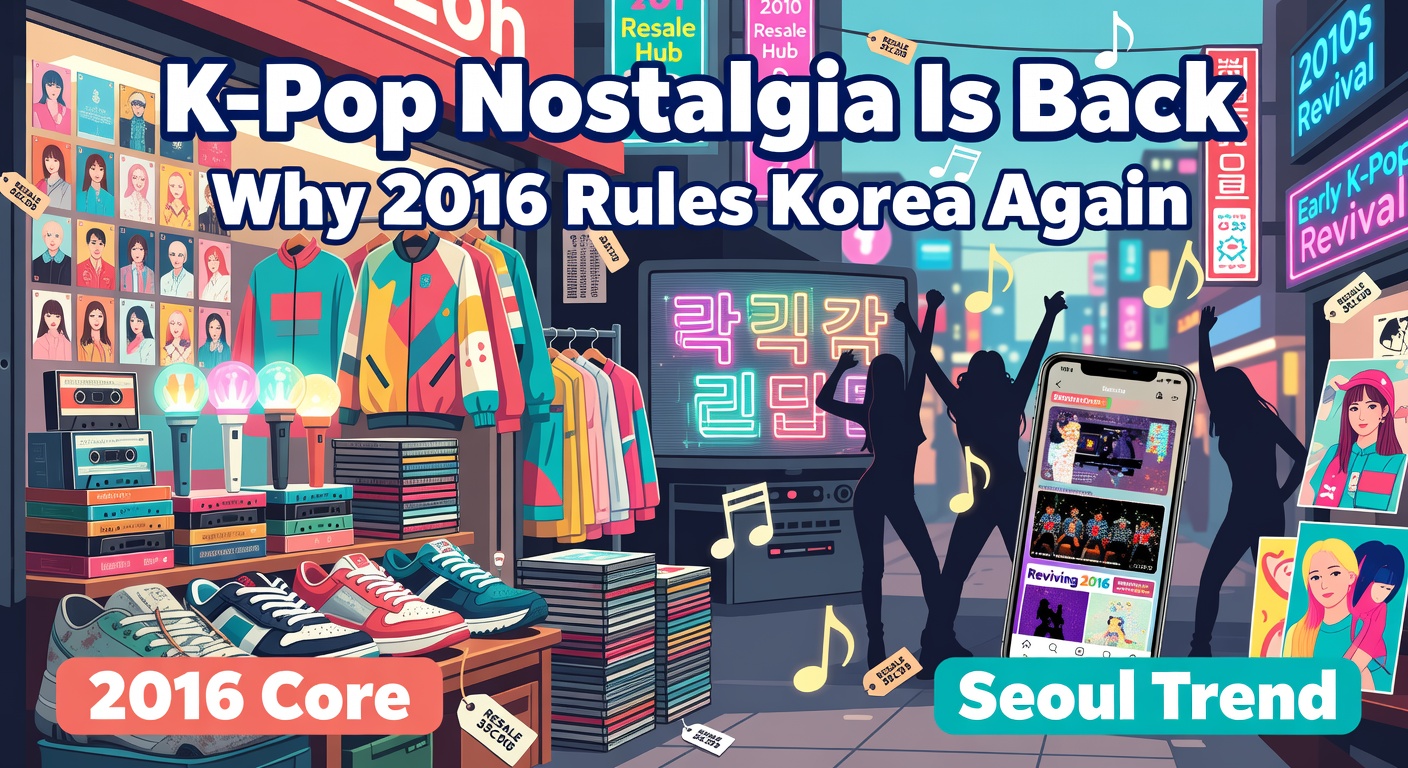
What "K-Pop Nostalgia" Actually Means in 2026 Korea
The phrase gets thrown around loosely online, so it helps to pin down what Koreans themselves mean by it. K-Pop nostalgia in 2026 generally refers to the renewed interest in second-generation (mid-2000s to early 2010s) and third-generation (mid-2010s) idol groups — think Big Bang, 2NE1, Girls' Generation, SHINee, EXO, and early BTS. It is not just older fans replaying their teenage favorites. Young Koreans who were children during this era are now discovering these artists for the first time through curated playlists and short-form video.
Many people find the generational labels confusing, and for good reason. "First generation," "second generation," and "third generation" K-Pop do not have universally agreed-upon dates. Different Korean media outlets, music critics, and fan communities draw the lines differently. For this article, second generation covers roughly 2005 to 2012, and third generation covers 2012 to 2017 — the era most commonly referenced in the current nostalgia wave.
What makes 2026 special is the ten-year cycle effect. The groups and songs from around 2016 are hitting a sweet spot: old enough to feel like a different era, recent enough that the production quality still sounds modern. The term "2016-core" has taken hold on Korean social media to describe the specific aesthetic — the music video styles, the fashion, the choreography — that fans are recreating and celebrating right now.
The Numbers Behind the Trend
It is easy to dismiss nostalgia as a feeling, but the data tells a concrete story. According to Circle Chart's annual music industry analysis, domestic digital track consumption for K-Pop's current top 400 tracks has dropped roughly 49.7% compared to 2019. At the same time, streaming numbers for older second- and third-generation tracks have climbed steadily. This is not a decline in K-Pop interest — it is a redistribution of attention.
🔗 Korea Herald — K-Pop market data
A February 2026 government report from Korea's Ministry of Culture confirmed that K-Pop still accounts for between 31.8% and 38.1% of the Korean Wave's global recognition, with particularly strong footholds in North America, Latin America, and Southeast Asia. Within that global audience, researchers noted a visible resurgence of interest in second-generation acts like Big Bang and TVXQ in several markets.
Meanwhile, the resale economy tells its own story. Bungaejangter (번개장터), Korea's largest secondhand marketplace, published its 2025 Global K-Pop Merch Trend Report in January 2026, documenting sharp increases in transactions for vintage concert goods, retro photocards, and early-2010s layered fashion items among global fans.
🔗 Bungaejangter — 2025 K-POP Trend Report
| Indicator | K-Pop Nostalgia (2nd/3rd Gen) | Current K-Pop (4th Gen+) |
|---|---|---|
| Domestic digital streaming | Rising for older catalog tracks | Top 400 down ~49.7% vs 2019 |
| Primary platforms | YouTube, TikTok, resale markets | Spotify, Melon, live concerts |
| Consumption style | Playlists, dance challenges, vintage merch | New singles, short MVs, fan events |
| Fan demographic | 20s–30s revisiting + Gen Z discovering | Teens and early 20s |
| Global hallyu share | Part of K-Pop's 31.8–38.1% hallyu contribution | Same overall share |
One thing that trips people up: seeing that domestic K-Pop consumption is declining and concluding that K-Pop is dying. That is not what the data shows. Overall new-release streaming is down, but catalog listening — especially for the nostalgia era — is up. These two things are happening simultaneously, and confusing one for the other leads to misleading headlines.
Why 2016 Specifically? The Emotional Engine
The ten-year nostalgia cycle is well-documented across cultures, but Korea's version has a few unique accelerants. For Koreans now in their late twenties and early thirties, 2016 was a formative year. It was the peak of several iconic groups' careers, the height of certain variety shows, and the moment before several beloved idols enlisted in military service or went on hiatus.
Korean dramas and films have been amplifying this. Several K-dramas airing in 2025 and 2026 have used mid-2010s K-Pop hits as background music during coming-of-age flashback scenes, effectively turning those songs into shared generational markers. When a drama's 20-something protagonist hears a 2016 track and gets emotional, millions of viewers feel the same thing at once.
There is also the SNS effect. TikTok and Instagram Reels have turned nostalgia into a participatory sport. "Songs that take you back to 2016" is not just a playlist title — it is a content format. Users film reaction videos, recreate old choreography with deliberate imperfection, and post side-by-side comparisons of how they dressed then versus now. The algorithm rewards this emotional content with massive reach, which feeds more creation.
What makes K-Pop nostalgia different from, say, Western pop nostalgia is the performance memory at its core. While American or British nostalgia often centers on songs themselves, Korean nostalgia is deeply visual — it is about the specific music video aesthetics, the synchronized choreography, the behind-the-scenes practice room clips. The entire sensory package gets revisited, not just the audio.
How Nostalgia Shows Up in Korean Fashion and Daily Life
The nostalgia wave extends well beyond playlists. Walk through Myeongdong, Hongdae, or Garosu-gil and you will spot its influence in what people are wearing. The "vintage sportswear" trend that has swept Korean street fashion borrows directly from mid-2000s to early-2010s idol styling: oversized logo jumpers, layered accessories, low-rise denim with chunky sneakers. Fashion analysts have noted that elements of what some call "Granny-Core" in the West overlap with the K-Pop nostalgia wardrobe in Korea, but the Korean version carries distinct idol-era references.
🔗 K-Pop Fashion Trends in 2026
Vintage K-Pop merch has become a legitimate collector's market. Original concert T-shirts from 2012-era Big Bang or SNSD tours now command significant premiums on platforms like Bungaejangter. For visitors in Korea, this means the vintage and secondhand shops in Itaewon, Dongmyo, and online on apps like Karrot (당근) sometimes carry genuine K-Pop artifacts from this period.
Where many visitors get confused is assuming this is purely a fashion statement. For Koreans, wearing a retro K-Pop hoodie or collecting old photocards is an identity marker. It signals which generation of fandom you belong to, which era shaped your taste, and often opens up immediate social connections. If you are visiting Korea and want to connect with locals over shared pop culture, knowing even a little about second- or third-generation K-Pop goes surprisingly far.
Where to Experience K-Pop Nostalgia in Korea Right Now
If you are in Korea and want to experience this trend beyond your phone screen, several options are worth knowing about.
Record shops and listening bars in Hongdae and Ikseon-dong have started hosting themed nights dedicated to 2000s and 2010s K-Pop. These are not formal concerts but casual listening sessions where the DJ plays deep cuts from the era and the crowd sings along. They tend to be announced on Instagram a few days in advance, so following local venue accounts is the best way to catch them.
Vintage markets like the Dongmyo Flea Market and curated pop-up shops in Seongsu-dong regularly feature K-Pop memorabilia stalls. The Bungaejangter app is the go-to for online purchases, though navigating it in Korean can be a challenge — using the Papago translation app alongside it helps.
Karaoke (noraebang) remains the most accessible nostalgia experience. Every noraebang in Korea has an extensive back catalog. Singing second-gen hits with Korean friends is a reliable bonding experience, and many noraebang machines now show the original music videos alongside the lyrics for older tracks.
K-Pop exhibition spaces in Seoul occasionally feature retrospective exhibits. The HYBE Insight museum near Yongsan focuses on BTS and HYBE artists, but rotating exhibits sometimes touch on the broader K-Pop timeline. SMTOWN in Gangnam has similar retrospective elements for SM Entertainment's roster. Check each venue's current schedule before visiting — exhibits rotate and operating hours change seasonally.
The Global Dimension: Why This Is Not Just a Korean Thing
K-Pop nostalgia is rippling outward. The Korea Herald reported in early 2026 that Korea, Japan, and Indonesia were the top three K-Pop markets by YouTube views, and a noticeable portion of that viewership involved catalog content from earlier generations. In North and Latin America, the resurgence of interest in groups like Big Bang and 2NE1 has been documented in the government's hallyu trend report.
🔗 Buzzmag — K-Pop and the Resurgence of Nostalgia
For international fans visiting Korea, this creates a unique window. The nostalgia trend means that older K-Pop content is more visible, more celebrated, and more commercially available than it has been in years. You do not need to be up to date on 2026's newest debuts to participate in Korean pop culture conversations. Knowing the second- and third-gen classics might actually earn you more enthusiastic reactions from Korean friends and acquaintances than knowing the latest fourth-gen releases.
What catches people off guard is that this nostalgia is not backward-looking in a sad way. Koreans treat it as a celebration — a way of honoring music that shaped their identity during formative years. It coexists with excitement about new music. The mood is closer to "look how great this was" than "things were better back then."
What This Means if You Are Planning a Korea Trip
K-Pop nostalgia is not a separate itinerary item — it is a cultural lens that enriches whatever you are already doing in Korea. When you hear a familiar 2010s track playing in a Seoul cafe, when you see retro-styled concert merch in a Hongdae shop window, or when a Korean friend gets excited about a decade-old music video, you are witnessing one of the most organic cultural movements happening in Korea right now.
Understanding the trend also helps you make better decisions about what to buy, where to go, and how to connect. Vintage K-Pop merchandise makes a far more meaningful souvenir than generic tourist items. Nostalgia-themed cafe or bar nights offer more authentic cultural exchange than most packaged K-Pop tourism experiences. And simply knowing a few second-gen group names gives you a genuine conversation starter that Koreans of almost any age will respond to warmly.
The trend shows no signs of fading. As long as new ten-year anniversaries keep arriving and platforms keep rewarding emotional content, K-Pop nostalgia will keep evolving. For anyone interested in Korea — whether visiting, living here, or following from abroad — it is one of the most accessible entry points into understanding how Koreans relate to their own pop culture history.
Frequently Asked Questions
Q. Why is 2016 K-Pop trending again in Korea in 2026?
The ten-year nostalgia cycle has brought mid-2010s K-Pop back into the spotlight. Koreans now in their late twenties and thirties are revisiting music from their formative years, amplified by TikTok challenges, YouTube playlists, and K-dramas using 2016-era songs as emotional soundtracks. Together, these forces have made "2016-core" a widely used label in Korean social media.
Q. Is K-Pop losing popularity in Korea?
Not exactly. Circle Chart data shows that domestic streaming of new K-Pop releases has declined roughly 49.7% compared to 2019, but catalog listening for older tracks is rising. The overall interest in K-Pop has not disappeared — it has shifted, with more attention going to established second- and third-generation artists alongside newer acts.
Q. Where can I buy vintage K-Pop merch in Seoul?
The Dongmyo Flea Market and pop-up shops in Seongsu-dong are good starting points for in-person shopping. Online, the Bungaejangter (번개장터) app is Korea's largest secondhand marketplace and has a large K-Pop memorabilia section. Always check seller ratings and inspect items for counterfeits, especially for popular groups.
Q. What K-Pop groups are considered second generation?
Second-generation K-Pop generally refers to groups active from the mid-2000s to the early 2010s, including Big Bang, 2NE1, Girls' Generation (SNSD), SHINee, Super Junior, and TVXQ. The exact boundaries vary depending on the source, so it helps to specify which years you mean when discussing generational labels.
Q. How can I experience K-Pop nostalgia as a tourist in Korea?
Visit a noraebang and sing second-gen classics, check out themed listening nights at Hongdae or Ikseon-dong bars, browse vintage merch at flea markets, or explore K-Pop exhibition spaces like SMTOWN in Gangnam. Following local venue Instagram accounts helps you catch pop-up nostalgia events announced on short notice.

Korea Travel Guide Creator
Practical Korea travel, food, and culture guides for foreign visitors.
View all posts →