Korean Convenience Store Foods — Your First Night Survival Guide
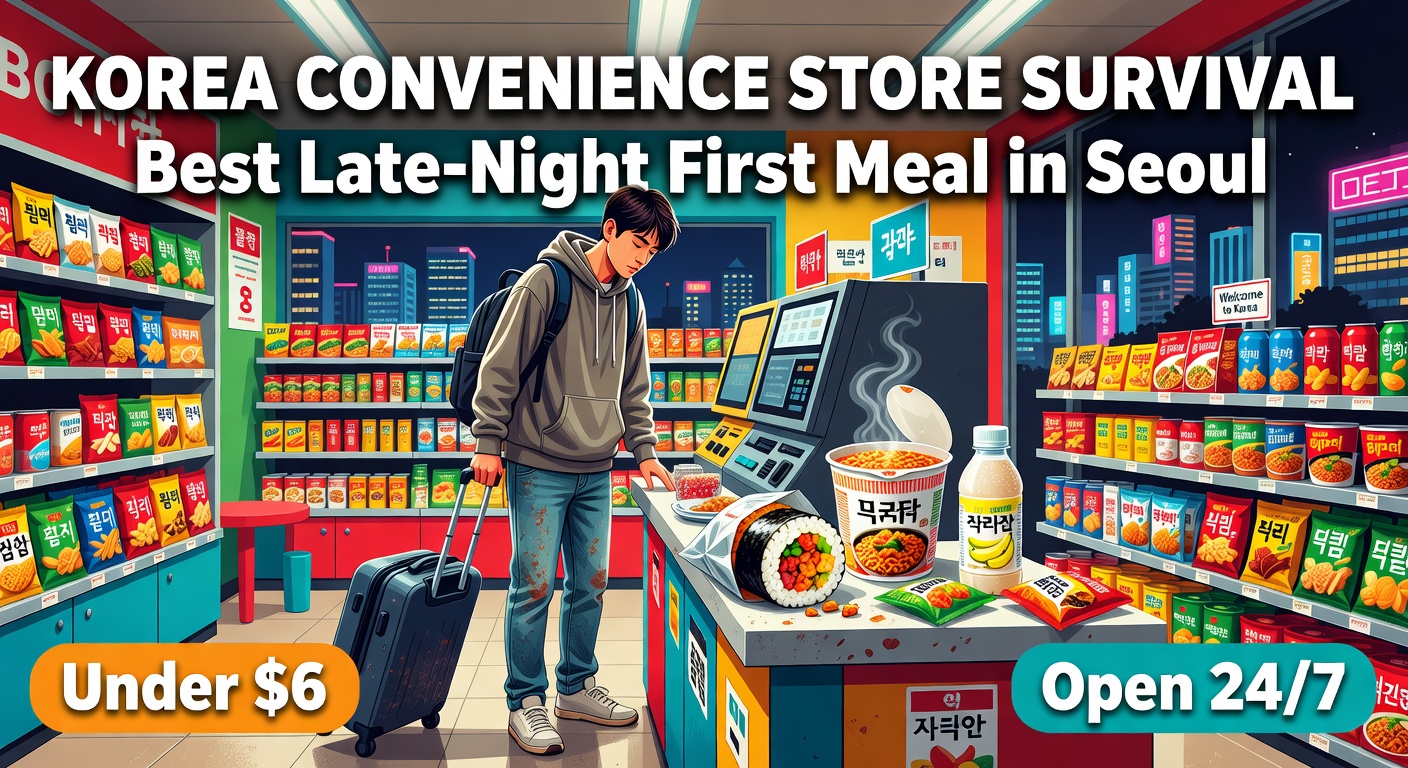
You just landed at Incheon, cleared immigration, and dragged your bags to the hotel. It's 11 PM, you're starving, and every restaurant nearby has already closed. This is the exact moment Korean convenience stores become your best friend — and honestly, the food is better than you'd expect.
Korea's four major convenience store chains — CU, GS25, 7-Eleven, and Emart24 — run 24 hours and stock far more than chips and candy. From triangle kimbap to hot soup noodles, you can put together a genuinely satisfying first meal for around 7,000–8,000 won (roughly $5–$6). This article breaks down what to grab, what to skip, and how to navigate the store like someone who's done it before.
The Big Three: What to Eat First
If you only grab three things, make them these: a samgak-gimbap (삼각김밥, triangle kimbap), a cup of instant ramyeon (라면), and a banana milk (바나나우유). This trio has become almost a ritual for first-time visitors, and there's a practical reason for it — they're cheap, filling, and available in every single store.
Samgak-gimbap is a triangular rice ball wrapped in seaweed, filled with tuna mayo, kimchi, bulgogi, or other options. Prices sit between 1,500 and 3,000 won depending on the filling. The tricky part that catches many people off guard is the packaging — there's a specific pull sequence (pull tab 1, then 2, then 3) printed on the wrapper. Get it wrong and the seaweed tears apart. Take five seconds to read the numbers before ripping.
Cup ramyeon costs around 1,500 won. Shin Ramyun is the safe classic — spicy but manageable. Buldak Bokkeum Myeon (불닭볶음면, fire chicken noodles) is the one you've seen in YouTube challenges. It's legitimately painful for most people on the first try. If you want noodles without the burn, look for Jin Ramen Mild (진라면 순한맛) or Ansungtangmyeon (안성탕면), both of which have a savory broth without the aggressive heat.
Banana milk (바나나맛 우유) is Korea's unofficial comfort drink — a sweet, creamy banana-flavored milk in a squat plastic bottle. At around 1,200 won, it's the cheapest mood-lifter in the store. Milkis, a carbonated milk-and-yogurt soda, is another traveler favorite if you want something fizzy.
What often trips people up here is temperature. Cup ramyeon needs hot water, and every Korean convenience store has a hot water dispenser — but it's not always obvious where it is. Look near the microwave station or ask the clerk. Speaking of microwaves, they're free to use, and the staff will heat things for you if you ask.
Beyond the Basics: Snacks and Drinks Worth Exploring
Once you've handled hunger, the snack aisle is where Korean convenience stores really separate themselves from what you're used to back home.
Hotbar (핫바) is a fish cake sausage on a stick, sitting in a warmer near the register. It costs 1,000 to 2,000 won and tastes best dipped in the mustard and ketchup dispensers nearby. Hoddeok (호떡), a sweet pancake filled with brown sugar syrup, sometimes appears in the heated section too — grab one if you see it, because stock varies by store.
For chips, Saewookkang (새우깡, shrimp chips) is the Korean equivalent of what Doritos is in the US — ubiquitous and oddly addictive. The spicy version packs more punch than you'd expect from a snack chip. Kkobuk Chip (꼬북칩, turtle chips) comes in multiple flavors and has a layered, airy crunch that's unlike standard potato chips.
On the drinks side, you'll find a surprisingly wide range of flavored soju cocktails, fruit makgeolli, and canned highballs. CU's sherbet highball (샤베트 하이볼) launched in late 2025 and sold out repeatedly — if you spot it, it's worth trying. One important note: alcohol purchases require you to be 19 or older by Korean age counting, and clerks may ask to see your passport.
Which Convenience Store Chain Should You Visit?
You'll likely walk into whichever store is closest, and that's fine — all four chains carry the essentials. But each has slight strengths worth knowing if you have options.
| Chain | Best for | Standout items | Price range |
|---|---|---|---|
| CU | Trendy snacks, desserts, alcohol | Sherbet highball, Dubai chapssaltteok | Budget-friendly, lots of new releases |
| GS25 | Solid everyday meals | Jumeokbap (rice balls), fresh cream cakes | Balanced pricing |
| 7-Eleven | Health-conscious options | Greek yogurt, strawberry compote (4,900₩) | Slightly premium |
| Emart24 | No-brand value items | Emart PB snacks, budget lunch boxes | Often cheapest |
A common point of confusion: some stores have seating areas and some don't. If you see a counter with stools by the window, that's the eating zone — feel free to sit and eat your ramyeon there. Not every location has one, though, especially smaller stores in subway stations.
How to Pay (and What to Watch Out For)
Korean convenience stores accept credit cards, debit cards, and mobile payments like KakaoPay and Samsung Pay. Cash works too, but many travelers arrive without Korean won — and that's fine, because international Visa and Mastercard are accepted everywhere.
One thing people commonly overlook: you need to grab a cup of water separately if you're eating ramyeon. The hot water is free, but drinking water usually means buying a small bottled water (500 won) or using the water cup dispenser if the store has one. It sounds minor until you're standing there with a mouth full of spicy noodles and nothing to drink.
Also, when you're done eating, separate your trash. Korean convenience stores have divided bins — general waste, plastic, and cans. Throwing everything into one bin is one of the most common etiquette mistakes visitors make, and staff do notice.
How Much a First-Night Convenience Store Run Actually Costs
Prices have risen recently — KBS reported an 8.2% increase in instant noodle prices as of early 2026, and private-brand items at some chains have gone up by as much as 25%. Even so, a convenience store meal remains one of the cheapest eating options in Korea.
Here's a realistic first-night budget: two triangle kimbap (3,000–4,000 won total), one cup ramyeon (1,500 won), a banana milk (1,200 won), and maybe a hotbar (1,500 won). That's a full, satisfying meal for around 7,000–8,000 won — roughly $5 to $6. Add a beer or soju and you're still under 12,000 won.
For context, a sit-down restaurant meal in Seoul now averages over 10,000 won per person for lunch. The convenience store isn't just convenient — it's a genuinely budget-smart choice, especially on night one when you're too tired to navigate a Korean menu.
What surprises most first-timers is that Korean convenience store food doesn't taste like convenience store food as they know it. The kimbap is made fresh (or near-fresh), the lunch boxes use real rice and proper banchan, and the desserts rival what you'd find in a bakery. This isn't gas station hot dogs — it's a legitimate food culture.
What to Skip (At Least on Night One)
Not everything in the store is a winner for a first-timer. Pre-made sandwiches tend to be hit-or-miss and often have unexpected fillings like sweet potato or egg salad with sugar. The ultra-spicy ramyeon varieties (anything with "2x" or "핵" on the label) are better saved for when you know your tolerance level.
Frozen meals that require a microwave can be decent, but the instructions are entirely in Korean. If you're too tired to figure out cook times and power levels, stick with ready-to-eat items or things that just need hot water.
Also, trendy limited-edition items — like CU's Dubai chapssaltteok (두바이 찹쌀떡, a mochi-style rice cake that went viral) — sell out fast. Availability depends heavily on location and timing, so don't plan your entire evening around a specific product.
Conclusion
Your first night in Korea doesn't require a restaurant reservation or a food tour. Walk into any CU, GS25, 7-Eleven, or Emart24 — they're never more than a few minutes away — and grab a triangle kimbap, a cup of ramyeon, and a banana milk. You'll spend under 7,000 won, eat something genuinely good, and get your first real taste of everyday Korean food culture. Save the barbecue and fried chicken for tomorrow when you've slept. Tonight, the convenience store has you covered. Prices and limited-edition availability shift regularly — the figures here reflect early 2026, so a quick shelf check before budgeting is always a good idea.
Frequently Asked Questions
Q. Are Korean convenience stores open 24 hours?
Yes, all four major chains — CU, GS25, 7-Eleven, and Emart24 — operate 24 hours a day, seven days a week. This applies to the vast majority of locations, including those near airports, train stations, and tourist areas.
Q. Can I use a foreign credit card at Korean convenience stores?
International Visa and Mastercard are accepted at virtually all Korean convenience stores. You don't need Korean won in cash to buy food, though having some small bills is helpful for vending machines or street vendors outside the store.
Q. What is the spiciest thing to avoid at a Korean convenience store?
Buldak Bokkeum Myeon (불닭볶음면), especially the 2x and 3x spicy versions, consistently catches first-timers off guard. If you see "핵" (nuclear) or "2배" (double) on any ramyeon package, that's your warning sign. Stick with Jin Ramen Mild or Ansungtangmyeon if you prefer a gentler introduction.
Q. How much does a convenience store meal cost in Korea in 2026?
A basic meal — one or two triangle kimbap plus a cup ramyeon and a drink — runs between 5,000 and 8,000 won (about $3.50–$5.50). Prices have risen slightly in 2026 due to food inflation, but convenience stores remain one of the most affordable meal options in Korea.
Q. What is samgak-gimbap and how do you open it?
Samgak-gimbap (삼각김밥) is a triangular rice ball wrapped in seaweed with fillings like tuna mayo, kimchi, or bulgogi. The plastic wrapper has numbered tabs — pull tab 1 first (across the top), then tabs 2 and 3 (down each side) to cleanly separate the seaweed from the packaging. Following the numbered sequence keeps the seaweed intact.
Recommended Posts

Korea Travel Guide Creator
Practical Korea travel, food, and culture guides for foreign visitors.
View all posts →