Korea Cherry Blossoms 2026 — Bloom Timing Guide for Jeju, Busan & Jinhae
If you have been refreshing bloom forecast pages and wondering whether to book flights for late March or early April, you are not alone. Cherry blossom season in southern Korea lasts barely ten days per region, and mistiming your trip by even a weekend means you could arrive to bare branches or scattered petals on the ground.
Here is what we know right now: according to the Korea Meteorological Administration's forecast released on March 20, 2026, southern Korea's cherry blossoms are arriving two to three days earlier than average this year. Jeju's peak bloom is expected around March 26, Busan around March 31, and Jinhae around April 3 — with a margin of plus or minus three days depending on temperature shifts. This article breaks down the latest forecast dates, the best spots in each region, and how to avoid the worst crowds so you can lock in your plans.
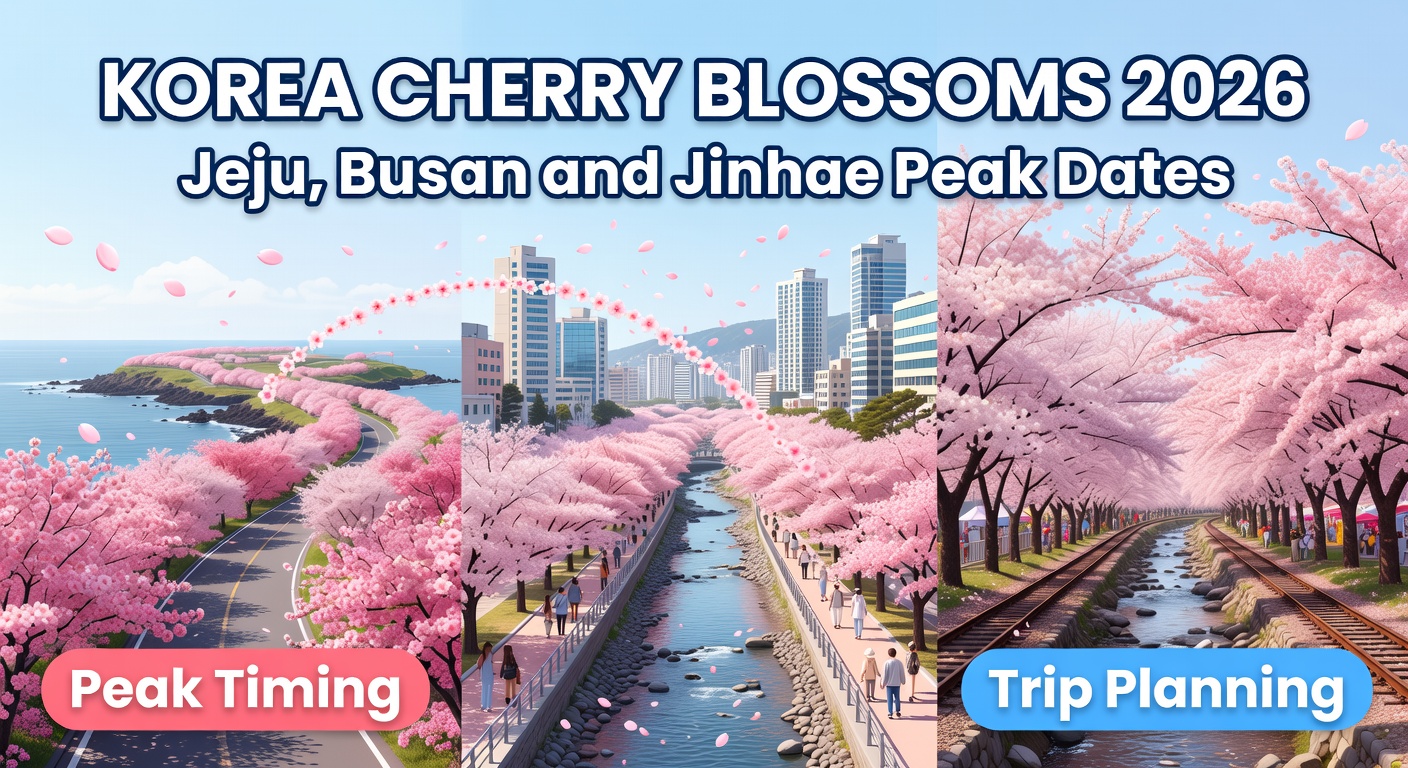
When Exactly Do the Blossoms Peak?
The gap between "first bloom" and "full bloom" is about seven to nine days in each region. Many people confuse these two dates, which is where most timing mistakes happen. First bloom means a handful of flowers have opened on a reference tree — not the tunnel of petals you see in photos. Full bloom is when roughly 80 percent of buds have opened, and that window lasts only three to five days before petals start falling.
| Region | First Bloom | Full Bloom (Peak) | Best Visit Window |
|---|---|---|---|
| Jeju | ~Mar 17 | ~Mar 26 | Mar 24–28 |
| Busan | ~Mar 23 | ~Mar 31 | Mar 29–Apr 2 |
| Jinhae | ~Mar 25 | ~Apr 3 | Apr 1–5 |
The Korea Meteorological Administration notes that average temperatures in southern Korea's second half of March are running 0.5 to 1.0°C above normal this year, which is why the forecasts are slightly ahead of the historical average. Keep in mind that a sudden cold snap or heavy rain could shift these dates by up to three days in either direction.
If you are trying to see all three regions in one trip, the bloom wave moves roughly from south to north: Jeju first, then Busan, then Jinhae. A trip starting around March 25 and ending around April 4 could realistically cover all three, though that is an ambitious itinerary.
Jeju: Korea's Earliest Cherry Blossoms
Jeju's cherry trees are a distinct variety — the King Cherry tree (왕벚나무), which produces noticeably larger blossoms than what you will find on the mainland. The main viewing corridor is Jeonnong-ro in Jeju City, a roughly 1.2-kilometer street lined with hundreds of these trees forming a canopy overhead.
The Jeju King Cherry Blossom Festival runs from March 20 to 29 this year, centered around Jeonnong-ro and the Aewol coastal road. New for 2026, the festival area has been expanded to include the stretch from Jeju City Hall to the Jeju National Museum, according to the Jeju Tourism Organization's February announcement.
Where to go beyond the main street. Aewol's coastal cherry blossom road is worth the drive — it is less congested than Jeonnong-ro and offers ocean views alongside the blossoms. The village of Jangjeon is another quieter option. Many visitors underestimate how spread out Jeju's cherry blossom spots are and assume they can walk between them. Public transit connections between these areas are limited, so renting a car is strongly recommended.
Jeju's weather trap. One thing that catches people off guard is how quickly Jeju's weather can change. Strong gusts and sudden rain showers are common in late March, and they can knock petals off in a single afternoon. If your schedule allows, build in at least one buffer day. Arriving a few days before the predicted peak — say around March 22 to 24 — lets you catch the blossoms at 60 to 70 percent and gives you insurance against a rainy day wiping them out.
Busan: City Blossoms Without the Festival Crowds
Busan does not have one massive cherry blossom festival the way Jinhae does, which is actually an advantage. The viewing experience is more spread out across the city, and the crowds are more manageable outside of peak weekends.
The three main spots are Oncheon Stream (온천천), Dalmaji Hill (달맞이고개) in Haeundae, and Samnak Ecological Park (삼락생태공원) along the Nakdong River. Oncheon Stream is the most accessible — take Metro Line 1 to Oncheonjang Station and you are right there. The path along the stream is lined with cherry trees on both sides, creating that tunnel effect people travel for.
🔗 Oncheon Stream Park on Naver Map
Dalmaji Hill is a different experience — a hillside road above Haeundae Beach where cherry trees mix with pine trees and ocean views. It is better for a scenic drive or taxi ride than a walking route. Samnak Ecological Park is the quietest of the three and suits families or anyone looking for a relaxed afternoon.
The weekend problem. Based on social media reports and local guides, Busan's cherry blossom spots between noon and 3 p.m. on peak-bloom weekends can be uncomfortably packed, especially at Oncheon Stream. Parking delays of an hour or more are common in those windows. The fix is straightforward: visit on a weekday when you can, or arrive before 8 a.m. on weekends. Early morning light along Oncheon Stream is better for photos anyway.
If you are combining Busan and Jinhae, the bloom overlap is generous this year — roughly March 29 through April 3 covers both regions near peak.
Jinhae: Korea's Biggest Cherry Blossom Festival
The Jinhae Gunhangje (진해군항제) is Korea's largest cherry blossom festival, and the 2026 edition runs from March 27 to April 6. This is a notable change from previous years — Changwon city moved the opening date forward by about a week, recognizing that blooms are arriving earlier and attempting to spread out weekend visitor numbers.
🔗 Jinhae Gunhangje on Naver Map
The two most photographed spots are Yeojwacheon Stream (여좌천), where cherry trees arch over a narrow stream with a walking path, and Gyeonghwa Station (경화역), a decommissioned train station with railroad tracks running through a cherry tree corridor. Both are spectacular, and both get extremely crowded.
The festival-versus-bloom mismatch. This is where most people get tripped up when planning a Jinhae visit. The festival dates and the peak bloom dates do not always align perfectly. In 2026, full bloom is forecast around April 3, while the festival opens on March 27. If you arrive on opening weekend expecting a full canopy overhead, you may find the trees are only at 40 to 50 percent. The sweet spot this year is likely the first few days of April — roughly April 1 through April 5.
Getting there. Jinhae is part of Changwon city and does not have its own KTX station. Most visitors arrive via Changwon or Masan station and transfer by bus or taxi. Korail is running a special Cherry Blossom Train shuttle between March 25 and April 6, which drops passengers closer to the festival area — worth checking the Korail app for schedules. During the festival, vehicle access to the Yeojwacheon and Gyeonghwa Station areas is restricted, so driving directly there is not an option.
A quieter alternative within Jinhae. If the Yeojwacheon footpath crowds feel overwhelming, head to Jehwangsan Park (제황산공원). The observatory at the top gives you a panoramic view of Jinhae blanketed in white and pink blossoms — a completely different perspective from the street-level experience, with a fraction of the foot traffic.
How to Plan the Trip: Booking and Budget
Accommodation and transport prices spike sharply once bloom forecasts are confirmed. In practical terms, this means booking two to three weeks before your target dates — not the week of.
Budget snapshot. Based on Korea Tourism Organization data, a two-day, one-night cherry blossom trip per region runs approximately ₩250,000 to ₩400,000 per person (roughly $180 to $290 USD), covering accommodation, transport, and meals. Festival entry at Jinhae, Busan, and Jeju's main cherry blossom areas is free.
One thing that surprises many visitors is the cancellation policy during peak season. For the holiday window from roughly March 28 through April 6, stricter refund policies often apply — some accommodations only offer 50 percent refunds for cancellations made five or fewer days before check-in.
Alternatives if You Miss the Southern Bloom
If your schedule does not align with the southern bloom window, there are solid backup options.
Seoul and Gyeonggi. Yeouido's Yunjung-ro and Seokchon Lake near Lotte World typically hit full bloom around April 4 to 10. A "south first, Seoul later" itinerary works well — you can catch the tail end of Jinhae blooms and then head to Seoul for a second wave.
Daegu and Gyeongju. If Jinhae's crowds are a dealbreaker, Daegu's Duryu Park and Gyeongju's Bomun Lake area bloom in a similar window (roughly March 27 to April 3) with significantly fewer visitors. These are not unknown spots, but they are far less saturated than Jinhae during the festival.
What to Prepare Before You Go
Pack layers. Late March and early April mornings in southern Korea hover around 8 to 12°C, warming to 16 to 20°C by afternoon. Jeju adds wind chill to the equation. A light jacket you can remove easily is more useful than a heavy coat.
Comfortable walking shoes matter more than you might think — Jinhae's festival circuit and Busan's Oncheon Stream path both involve substantial walking on pavement, and the crowds slow everything down.
For real-time bloom tracking once you are in Korea, search "벚꽃 개화" (cherry blossom bloom) on Naver — you will get near-live updates from locals posting photos. Instagram geotags for specific locations also work well for checking current conditions.
One last practical note: carry a portable battery. Between navigation apps, bloom forecast pages, and the photos you will inevitably take, your phone battery drains faster than usual during a full day of festival walking.
Festival schedules, access restrictions, and transport arrangements can shift as the season approaches — verify the latest details through official tourism sites or local announcements before you depart.
Conclusion
The 2026 cherry blossom season in southern Korea is shaping up to arrive a few days earlier than usual. If you are targeting the southern trifecta of Jeju, Busan, and Jinhae, the core window is roughly March 24 through April 5, with each region peaking about a week apart. The single most important thing you can do right now is book accommodation and transport for your target dates — prices are already climbing, and availability near Jinhae and Jeju City thins out fast once the forecasts are confirmed. After that, plan for weekday visits or early mornings, and build in one flexible day as weather insurance.
Frequently Asked Questions
Q. When is full bloom for cherry blossoms in Korea 2026?
Full bloom in 2026 is forecast around March 26 for Jeju, March 31 for Busan, and April 3 for Jinhae. These dates carry a margin of plus or minus three days depending on actual temperatures in late March.
Q. Is the Jinhae Cherry Blossom Festival 2026 free to enter?
Yes, the Jinhae Gunhangje festival and all major cherry blossom viewing areas in Jinhae, Busan, and Jeju are free to enter. You will only spend on transport, food, and accommodation.
Q. How do I get to Jinhae for the cherry blossom festival?
Take the KTX to Changwon or Masan station and transfer by local bus or taxi. Korail is also running a special Cherry Blossom Train shuttle from March 25 to April 6 that stops closer to the festival area. Driving directly into the festival zone is restricted during the event.
Q. Can I see cherry blossoms in Jeju, Busan, and Jinhae in one trip?
It is possible if you plan around 10 to 12 days, starting in Jeju around March 24 and ending in Jinhae around April 4. A shorter version covering Busan and Jinhae together is easier — their bloom windows overlap from roughly March 29 to April 3.
Q. What happens if it rains during cherry blossom season in Korea?
Heavy rain or strong wind can knock petals off quickly, sometimes shortening the full bloom window by a day or two. Jeju is especially prone to sudden weather changes. Building one or two buffer days into your itinerary is the best insurance against losing your viewing window to weather.

Korea Travel Guide Creator
Practical Korea travel, food, and culture guides for foreign visitors.
View all posts →