Korean Etiquette Rules for Foreigners: 15 Tips to Avoid Awkward Moments
You have your flights booked, your itinerary is coming together, and then a thought creeps in: what if you accidentally offend someone in Korea without even realizing it? Maybe you have heard that pouring your own drink is a faux pas, or that writing someone's name in red ink is considered bad luck. The anxiety is real, and it is one of the most common concerns first-time visitors share online.
This article covers 15 practical etiquette rules that will keep you comfortable in everyday Korean situations — from greeting strangers and sharing meals to riding the subway and visiting temples. These are based on current cultural norms as of 2026, including updates from the Korea Tourism Organization's revised foreigner etiquette guide.
Greetings: The Bow Comes First
When you meet someone in Korea for the first time, a slight bow of the head is the standard greeting. You do not need to bend at a 90-degree angle — a gentle nod of about 15 degrees is perfectly fine for casual encounters. If someone extends their hand for a handshake, take it with your right hand and support your right forearm lightly with your left hand. This two-handed gesture signals respect and is one of the first things Koreans notice.
Many people find the handshake part confusing because it looks different from what they are used to. The key thing to remember: when shaking hands with someone older or in a higher position, always use both hands. A one-handed shake is not rude, but the two-handed version shows you understand the culture.
The Korea Tourism Organization's 2025 English guide notes that both a light bow and a friendly wave are now considered acceptable greetings in casual settings, reflecting a gradual softening of formality among younger Koreans. But when in doubt, the bow is always safe.
Age Matters More Than You Think
One of the first questions a Korean person might ask you is "How old are you?" This is not nosy — it is how people figure out the appropriate level of formality to use with you. Korean social interactions are deeply shaped by age-based hierarchy, and knowing someone's age helps determine who speaks formally to whom.
Since June 2023, Korea officially switched to the international age system (man nai, 만 나이), which counts age the same way most countries do. Before that, Koreans used a system where you were already one year old at birth and gained another year every January 1st. In casual conversation, some people still reference the old system, so do not be surprised if someone's "Korean age" seems a year or two higher than expected.
The practical takeaway: if someone asks your age, answer honestly and do not take offense. It is a social tool, not an interrogation.
Formal Speech Is the Default
Korean has distinct levels of formality built into the language itself. When meeting someone for the first time, Koreans use jondaenmal (존댓말, formal/polite speech). Switching to banmal (반말, casual speech) only happens after the other person explicitly suggests it — usually with the phrase "mal pyeonhage haja" (말 편하게 하자, meaning "let's speak casually").
If you are learning Korean, this is where most foreigners trip up. Using casual speech too early — even if you mean it warmly — can come across as disrespectful. The safest approach is to stick with polite endings (-yo forms) until someone invites you to relax.
Even if your Korean is limited to a few phrases, saying "annyeonghaseyo" (안녕하세요) instead of the casual "annyeong" (안녕) makes a noticeable difference in how people respond to you.
Dining Etiquette: Wait for the Elder
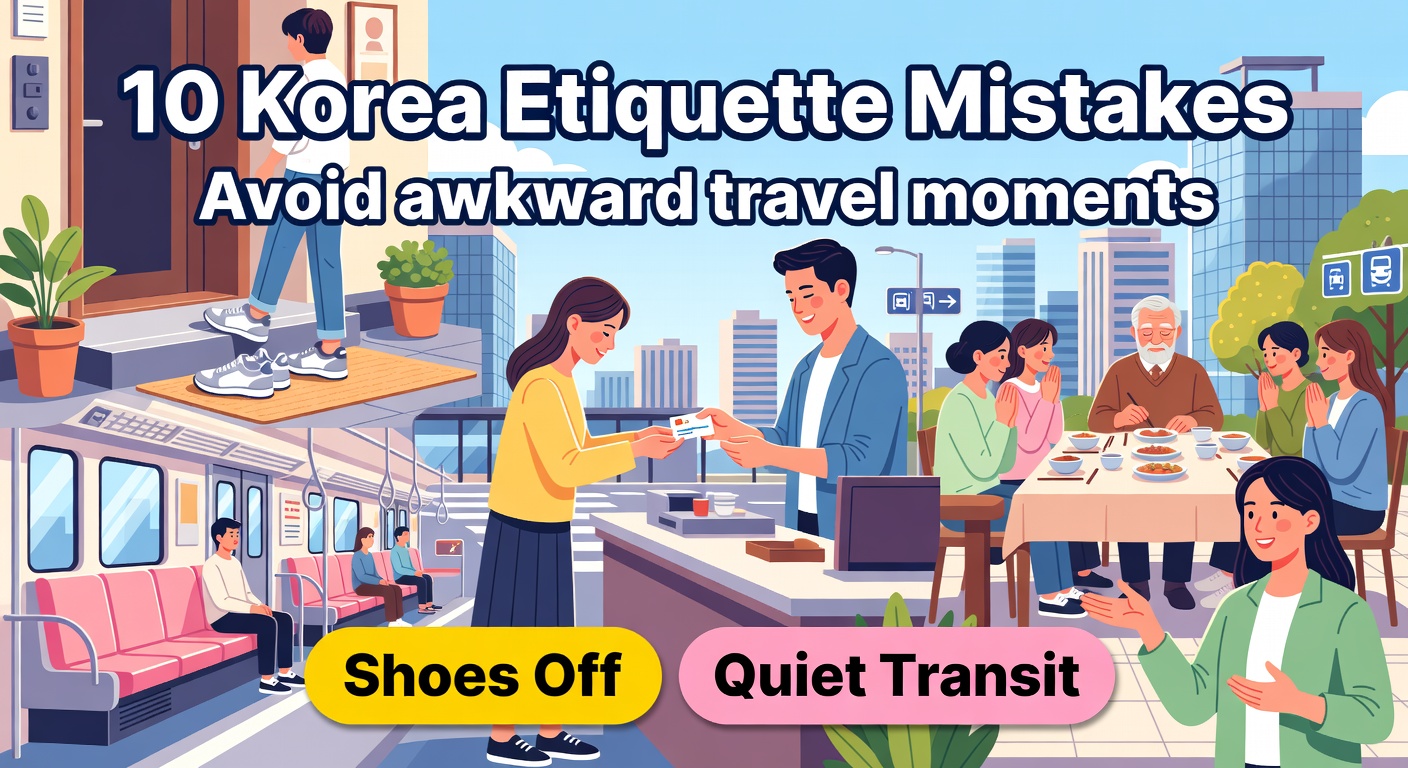
Korean meals are communal, and the table has unspoken rules. The most important one: do not pick up your chopsticks or spoon until the eldest person at the table starts eating. This applies at restaurants, family dinners, and work gatherings alike.
Other dining norms that catch visitors off guard:
Do not blow your nose at the table. If you need to, excuse yourself and step away. Pouring your own drink is generally avoided in group settings — pour for others, and someone will pour for you. When receiving a drink from someone older, hold your glass with both hands as a sign of respect.
A common point of confusion is the drinking culture at work dinners (hoesik, 회식). Declining alcohol used to be socially difficult, but workplace culture has shifted considerably. Many companies now respect personal choices about drinking. That said, the atmosphere varies by company and team — politely holding a glass of something non-alcoholic is a safe middle ground if you prefer not to drink.
Shoes Off at the Door
This one is simple but easy to forget in the moment. Remove your shoes before entering someone's home, many traditional restaurants, temples, and some guesthouses. You will usually see a row of shoes near the entrance — that is your cue.
Most Korean homes and ondol-floor restaurants have a small step up from the entryway, marking the boundary between shoes-on and shoes-off zones. Slippers are sometimes provided, but bringing clean socks is a good habit. Walking barefoot on someone's floor can feel a bit too casual.
The Subway Has Unwritten Rules
Korea's subway system is efficient and well-organized, but it has a few social norms that are not posted on signs. The most important: priority seats (noyangjaseok, 노약자석) are reserved for the elderly, pregnant women, and disabled passengers. Even if the seats are completely empty and the train is packed, most Koreans will not sit there. Following this unwritten rule avoids uncomfortable stares.
Keep phone calls short or avoid them entirely on the train. Loud conversations between friends also draw attention. Seoul's 2025 public etiquette campaign added a new guideline about keeping earphone volume at a reasonable level — a sign of how seriously public noise is taken.
| Etiquette Point | Korean Norm | What Many Visitors Expect |
|---|---|---|
| Greeting style | Light bow, two-handed handshake | One-handed handshake or hug |
| Addressing people | Title or age-based honorific | First name from the start |
| Starting a meal | Wait for the eldest to begin | Start when food arrives |
| Tipping | Not expected, can cause discomfort | 10–15% standard |
| Priority subway seats | Left empty even when train is full | Available if unoccupied |
| Phone calls on trains | Avoided or kept very brief | Normal in many countries |
Giving and Receiving with Both Hands
Whether it is a business card, a gift, a credit card, or even change from a cashier — using both hands to give and receive objects is a core Korean courtesy. When handing something to someone older or in a professional setting, extend the item with your right hand while lightly supporting your right arm with your left.
This applies to business card exchanges as well. When someone gives you their card, take it with both hands, look at it for a moment, and place it respectfully on the table or in a cardholder. Stuffing it straight into your pocket is considered careless.
For gift-giving, bring something small and nicely wrapped when visiting someone's home for the first time. Fruit sets, quality snacks, or something from your home country all work well. Avoid giving sets of four (the number is associated with death, similar to some other East Asian cultures), and skip red or dark-colored wrapping paper.
Tipping Is Not a Thing
Korea does not have a tipping culture. In restaurants, cafes, taxis, and hotels, the listed price is the final price. Attempting to leave a tip can actually make the situation awkward — staff may chase you down thinking you forgot your change, or feel uncomfortable accepting money they see as unnecessary.
For most first-time visitors, this turns out to be one of the most pleasant surprises about Korea — though it still takes a few days to stop automatically reaching for extra cash after a meal.
Temples and Sacred Spaces
When visiting Buddhist temples (and Korea has stunning ones throughout the country), modest clothing is expected. Avoid sleeveless tops, short shorts, and hats inside temple halls. Some temples provide shawls or coverings at the entrance, but it is better to dress appropriately from the start.
Photography rules vary from temple to temple. Some allow photos in the courtyard but not inside the main halls. Others restrict photography entirely during ceremonies. If there is no clear signage, ask before shooting. The Cultural Heritage Administration's visitor guidelines recommend checking each temple's official website before your visit.
Physical Contact Has Different Boundaries
Physical touch follows different rules in Korea compared to many Western countries. Patting someone on the head — even a child's — is considered rude. Slapping someone on the back as a friendly gesture can also be taken the wrong way, especially with someone you have just met.
On the other hand, you will notice that close friends of the same gender walk arm-in-arm or hold hands, which is simply a sign of friendship and carries no romantic connotation. This surprises many first-time visitors, but it is completely normal.
Saying No the Soft Way
Direct refusal feels harsh in Korean social contexts. If someone offers you food and you do not want it, saying "I'm okay for now" (jigeumeun gwaenchana-yo, 지금은 괜찮아요) is much smoother than a flat "no." The same applies to invitations and suggestions — a gentle deflection is always preferred over blunt rejection.
This also works in reverse. When a Korean person says "it might be a little difficult" or "let me think about it," they may be politely declining. Reading between the lines takes practice, but understanding this pattern will save you from misreading situations.
Noise Curfew After 10 PM
If you are staying in a guesthouse, Airbnb, or any shared residential building, keep noise levels down after 10 PM. Korea enforces noise control ordinances in residential areas nationwide, and neighbors will not hesitate to file complaints. This is especially relevant in apartment buildings (APT, 아파트), where sound carries easily between floors.
Running a washing machine late at night, playing music without headphones, or having a loud video call can all trigger issues. This norm catches many visitors off guard because it is strictly observed even in areas with active nightlife nearby.
Queuing and Personal Space
Koreans queue neatly for buses, subway doors, elevators, and food lines. Cutting in line — even unintentionally — draws immediate negative attention. At subway stations, you will see painted lines on the platform showing where to stand while waiting. Stick to these and let passengers exit before you board.
Personal space norms can feel inconsistent to visitors. In crowded markets or rush-hour trains, body contact is unavoidable and nobody apologizes for it. But in less crowded settings, maintaining a comfortable distance is expected. The contrast takes some getting used to.
Bargaining with a Smile
At traditional markets like Namdaemun or Gwangjang, light bargaining is acceptable — but only with a friendly attitude. Aggressive haggling or acting offended at the initial price will not win you any discounts. A warm smile, a polite "Could you give a small discount?" (jogeum kkakka juseyo, 조금 깎아 주세요), and genuine interest in the product go a long way.
In regular shops, department stores, and convenience stores, prices are fixed. Do not attempt to negotiate there.
Business Card and Meeting Etiquette
If your trip involves any professional meetings, the business card exchange is a small ceremony worth getting right. Present your card with both hands, print side facing the recipient. When you receive one, study it briefly — this shows you value the person and their position. Place it on the table during the meeting rather than tucking it away immediately.
Arriving a few minutes early to meetings is expected. Being late, even by five minutes, without advance notice is taken more seriously than in many other cultures.
Making It All Work
Korean etiquette comes down to one principle: show respect through small, deliberate actions. You do not need to memorize every rule perfectly. Koreans are generally understanding of foreigners who make honest mistakes, and a genuine effort to be polite goes further than flawless execution.
Start with the basics — bow when greeting, use both hands, wait for elders at meals, and keep your voice down in public. These four habits alone will cover most everyday situations. Everything else you can pick up as you go, and most Koreans will appreciate the effort more than you might expect.
Frequently Asked Questions
Q. Is it rude to refuse alcohol in Korea?
Workplace drinking culture has relaxed significantly in recent years. While some traditional companies still expect participation, most modern workplaces respect personal choices about alcohol. Politely declining with a soft explanation like "I don't drink, but I'm happy to be here" is widely accepted. Holding a non-alcoholic beverage is a comfortable alternative.
Q. Do I need to bow every time I greet someone in Korea?
A slight nod of the head is sufficient for most casual encounters like meeting friends or greeting shop staff. Deeper bows are reserved for formal situations such as business meetings, meeting elders for the first time, or ceremonies. You do not need to bow to cashiers or taxi drivers — a friendly "annyeonghaseyo" is enough.
Q. Can I use chopsticks to eat rice in Korea?
Koreans typically use a spoon for rice and soup, and chopsticks for side dishes. Using chopsticks to eat rice is not a serious offense, but using the spoon is the local standard. Also avoid sticking chopsticks vertically into a bowl of rice, as this resembles a funeral ritual.
Q. What happens if I accidentally sit in the priority seats on the subway?
Nobody will physically remove you, but you may receive pointed looks from other passengers. If an elderly person or pregnant woman boards the train, you will be expected to move immediately. The safest approach is to simply avoid these seats entirely — they are clearly marked in a different color.
Q. Should I bring a gift when visiting a Korean friend's home?
Yes, bringing a small gift is customary and appreciated. Fresh fruit, quality pastries, or something from your home country are safe choices. Present the gift with both hands. Avoid wrapping in dark colors, and skip gifts in sets of four. Your host will likely set the gift aside and open it later rather than in front of you — this is normal, not a sign of disinterest.

Korea Travel Guide Creator
Practical Korea travel, food, and culture guides for foreign visitors.
View all posts →