Seongsu-dong Cafe Street Guide — K-Drama Spots You Can Actually Visit
You just finished binge-watching Business Proposal and spotted that raw-concrete cafe where the leads shared an awkward coffee. Now you're in Seoul with two free hours and a phone full of screenshots, standing at Seongsu Station wondering which exit to take. Here's the thing most visitors get wrong right away: they walk out Exit 1 or 2 and end up in a quiet residential block, completely missing the cafe strip that's a seven-minute walk from Exit 3.
Seongsu-dong (성수동) sits in Seoul's Seongdong-gu district, a former shoe-factory and printing-press neighborhood that has transformed into what locals call "Seoul's Brooklyn." The converted warehouses, exposed-pipe interiors, and graffiti alleys make it a magnet for K-drama location scouts — and for the fans who want to walk those same streets with a latte in hand.
This guide maps out a realistic two-hour walking route through Seongsu's cafe corridor, flags the spots tied to specific dramas, and shares the timing tricks that keep you ahead of weekend crowds.
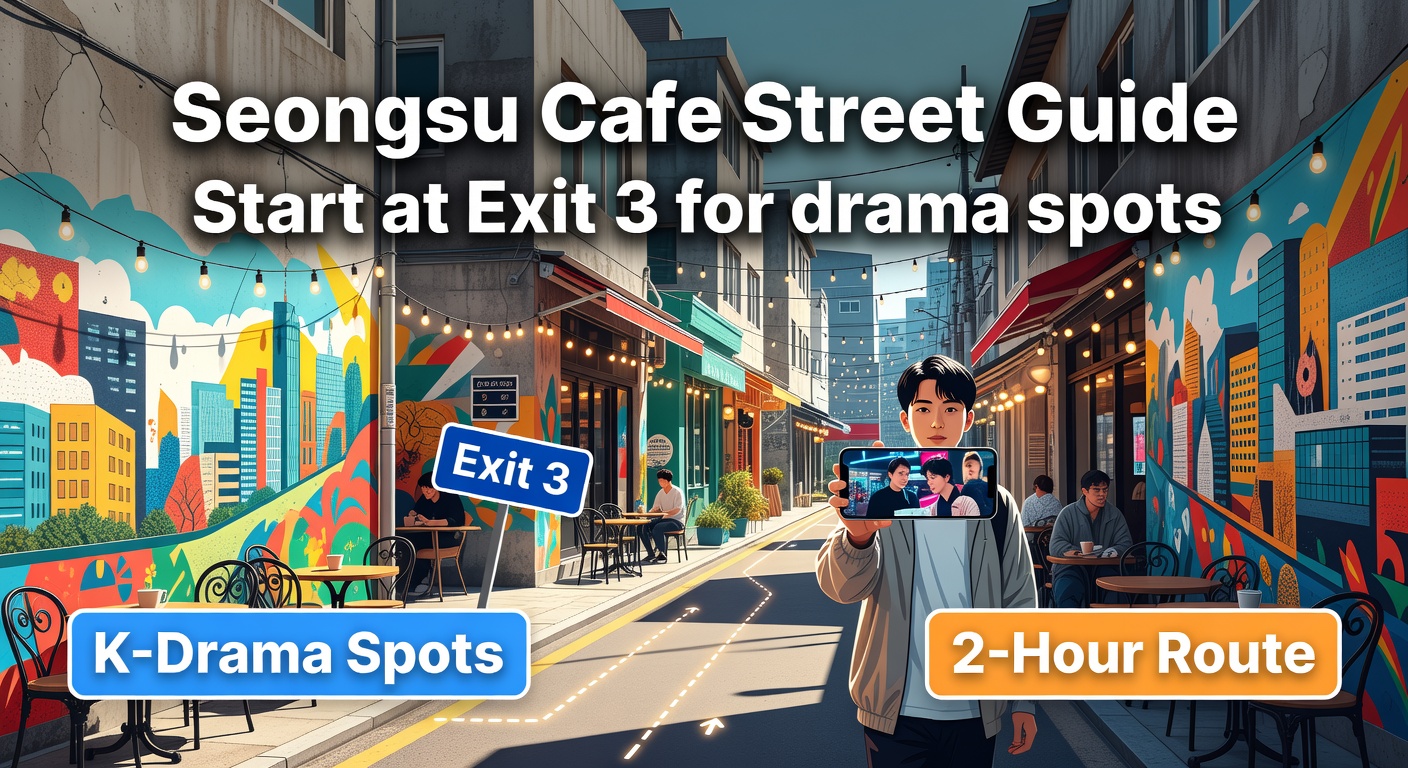
How to Get There Without the Confusion
Getting to Seongsu-dong is straightforward on paper — Seoul Metro Line 2, Seongsu Station — but the station has four exits, and picking the wrong one is the single most common mistake visitors make.
Exit 3 drops you directly into the narrow factory-alley grid where most cafes and converted spaces cluster. Walk straight for about seven minutes, and you'll hit the main cafe strip running along Seongsuro 170–175. Exit 4 leads toward the graffiti and mural alleys where several drama outdoor scenes were filmed. If street art and photo walls matter to you, start here and loop back.
From major hubs, travel times on Line 2 run roughly 25 minutes from Hongdae (Hongik University Station), 20 minutes from Gangnam, and 35 minutes from Seoul Station with one transfer. If you're coming from Incheon Airport, the Airport Railroad Express to Hongik University, then Line 2 eastbound, is the most reliable route.
One detail people overlook: there's no dedicated bus stop called "Seongsu Cafe Street." Bus riders should get off at the Seongsu Station stop and navigate from Exit 3 on foot. Taxi drivers know "성수 카페거리" (Seongsu kapeh-geori), but specifying "성수역 3번 출구" (Seongsu-yeok sambon chulgu) gets you closer to the action.
So you've made it to Exit 3 — now the question is where to walk first.
The Two-Hour K-Drama Cafe Route
The cafe district is compact enough to cover on foot in about two hours if you're selective. Trying to hit every spot turns a fun walk into an exhausting checklist, so this route prioritizes the places with real drama connections and strong coffee.
First Stop (10:00–11:00): Cafe Onion Seongsu and the Factory Core
Cafe Onion Seongsu is the neighborhood's anchor — a renovated factory with crumbling brick walls left intentionally exposed. It has appeared in the background of multiple K-drama scenes, most recognizably in outdoor walking shots from Business Proposal (사내맞선) and Yumi's Cells (유미의 세포들). The pastries are genuinely good, but the real draw is the building itself: stairwells with peeling paint, rooftop seating overlooking the alley, and corners that look exactly like drama stills.
Timing tip: Arrive by 10:00 on weekdays. Weekend lines start forming by 10:30, and by noon you're looking at a 20–30 minute wait just to order. Many first-time visitors show up at 2 PM on a Saturday and spend more time in line than inside.
From Onion, walk deeper into the alley grid toward Daelim Changgo (대림창고), another warehouse conversion. The surrounding blocks hold smaller cafes that rotate frequently — some last six months, others become fixtures. This turnover is actually part of Seongsu's character, but it means any "definitive list" is outdated within a season.
Second Stop (11:00–11:40): Mural Alleys and Drama Backdrops
Head toward the Exit 4 side of the neighborhood for the graffiti alleys. Several outdoor scenes from Itaewon Class (이태원 클라쓰) and Vincenzo (빈센조) used these narrow streets as backdrops — the industrial walls, metal staircases, and factory facades create a gritty visual that drama directors love.
Here's where most people get tripped up: exact filming locations are often unconfirmed. Production companies rarely publish specific addresses, and fan sites rely on frame-by-frame matching, which can be approximate. You'll find corners that look 90% like a scene from a particular angle, but the signage or paint may have changed since filming. If you're hoping for an exact recreation shot, temper expectations — you'll get close, not identical.
A few alley walls have small plaques or stickers noting drama appearances, but these are unofficial, placed by fans or cafe owners. Take them as helpful hints rather than verified records.
Third Stop (11:40–12:00): Toward Seoul Forest
The cafe strip's eastern edge connects to Seoul Forest (서울숲), a large park about a 15-minute walk from the core cafe area. If you have extra time, this extension adds greenery and a calmer pace. Several cafes along the Seoul Forest approach road offer terrace seating with park views — a nice contrast to the industrial aesthetic of the main strip.
This transition zone is where Seongsu blends back into a normal neighborhood, so the cafe density drops. It works best as a leisurely end to the walk rather than a destination on its own.
The route keeps things tight — but when you go matters more than where.
When to Go — And When to Avoid
Seongsu's cafe street is technically open around the clock as a public road, but most cafes operate between 10:00 and 22:00, with last orders around 21:00–21:30. Showing up at 8 AM or after 10 PM means walking past closed shutters, which is a surprisingly common complaint in online reviews from visitors who assumed "cafe street" meant round-the-clock service.
| Time Slot | Crowd Level | Best For | Watch Out |
|---|---|---|---|
| 10:00–11:30 weekday | Low | Photos, relaxed browsing | Some cafes open at 11:00 |
| 10:00–11:30 weekend | Medium | Early-bird advantage | Lines start building fast |
| 12:00–15:00 weekend | High | People-watching, energy | 20–40 min waits at popular spots |
| 15:00–17:00 any day | Medium-High | Afternoon light for photos | Some smaller cafes sold out |
| 18:00–21:00 | Medium | Dinner + evening cafes | Mural alleys poorly lit |
Seasonal notes: Spring (April–May) and autumn (September–October) are peak seasons when the factory-alley aesthetic photographs best. Summer heat pushes everyone indoors, making air-conditioned cafes more crowded. Winter thins out the terrace and rooftop crowd significantly — good for interiors, less appealing for street wandering.
Monday and Tuesday closures catch a lot of visitors off guard. Several Seongsu cafes follow the Korean indie-cafe pattern of closing on Mondays or Tuesdays, and some take an additional "third Monday" off monthly. Always check a cafe's Instagram before making it your anchor stop.
So what should you actually expect once you're inside?
What the K-Drama Scenes Don't Show You
K-dramas shoot Seongsu in golden-hour light with empty streets and perfectly styled interiors. Reality involves a few adjustments.
The industrial zone is still industrial. Active workshops, printing operations, and small factories sit between cafes. Weekday mornings involve delivery trucks navigating the same narrow alleys you're walking. This coexistence is authentic to Seongsu's identity, but it means the neighborhood doesn't look like a curated set from every angle. Based on reviews, visitors who expect a fully polished cafe village are the ones who leave disappointed.
Photography etiquette matters. Many cafes have posted rules about tripods, flash photography, and filming. The trend of recreating drama scenes with full ring lights and stabilizers has led some shops to restrict equipment. A phone or small camera is always fine; anything beyond that, ask staff first. Respecting other customers' space — not blocking seats for photo setups — goes a long way.
Cafes change fast. A spot that was packed six months ago might be closed today, replaced by a pop-up or a completely different concept. This rapid turnover is part of what keeps Seongsu interesting, but it also means blog posts and guides (including this one) have a shelf life. The street layout, major landmarks like Cafe Onion, and the general vibe are stable; individual smaller cafes are not.
That rapid turnover is worth keeping in mind when comparing Seongsu to other neighborhoods.
Seongsu vs. Other K-Drama Cafe Neighborhoods
If Seongsu doesn't fit your schedule or style, Seoul has several alternatives with their own drama connections.
| Neighborhood | Vibe | K-Drama Connections | Best For |
|---|---|---|---|
| Seongsu-dong | Industrial-chic, warehouse conversions | Business Proposal, Itaewon Class, Vincenzo, Twenty-Five Twenty-One | Cafe-hopping + street photography |
| Samcheong-dong | Hanok alleys, traditional + modern mix | Coffee Prince, various historical dramas | Hanok cafes + Gyeongbokgung combo |
| Yeonnam-dong | Colorful low-rise, indie shops | Hometown Cha-Cha-Cha (nearby filming) | Quirky independent cafes |
| Apgujeong/Sinsa | Luxury retail, polished aesthetics | Numerous rom-com shopping scenes | Brand flagships + upscale brunch |
Seongsu's distinct advantage is density — you can visit five to eight interesting cafes within a 15-minute walking radius, all with that converted-factory look that drama directors favor. Samcheong-dong spreads its cafes over a wider area and pairs better with palace visits. Yeonnam-dong is smaller and quieter. Apgujeong targets a different aesthetic entirely.
For K-drama fans specifically, Seongsu offers the highest concentration of backdrop locations in a single walkable zone. If your priority is a specific drama rather than a general cafe crawl, research the filming locations first — they may pull you to a completely different neighborhood.
A few practical details will make the difference between a smooth visit and a frustrating one.
Practical Checklist Before You Go
Budget: Coffee runs ₩5,000–₩8,000 per cup at most Seongsu cafes. Specialty drinks and dessert sets push toward ₩12,000–₩15,000. A two-hour cafe walk with two stops and a pastry typically costs ₩15,000–₩25,000 per person.
Transit cost: A single subway ride to Seongsu Station costs around ₩1,400–₩1,600 with a T-money card — check the Seoul Metro app for the current base fare before you go, as it adjusts periodically. From Seoul Station, one transfer on Line 1 to Line 2 keeps it at the same base fare plus a small distance surcharge.
What to wear: The alleys are uneven — cobblestones, metal grates, and occasional construction patches. Comfortable walking shoes beat anything fashionable but impractical. Several rooftop and terrace spots involve narrow staircases.
Language: Most Seongsu cafes have picture menus or basic English on their boards. Staff at the bigger spots (Cafe Onion, Daelim Changgo) generally handle English orders fine. Smaller places may require pointing at the menu or using a translation app — nothing unusual for Seoul.
Reservations: The cafe street itself requires no reservation or ticket. Individual cafes are almost entirely walk-in; a handful of specialty experience cafes (ceramic workshops, etc.) do take bookings, but standard coffee shops don't. The biggest queue-avoidance strategy is simply arriving before 11:00 on weekends.
Data/Maps: Naver Map is far more accurate than Google Maps for navigating Seongsu's alleys. Download it before your visit. Search "성수 카페거리" to center the map on the right area, then use it for individual cafe lookups with real-time hours.
Wrapping Up Your Seongsu Plan
Seongsu-dong rewards visitors who show up early, pick two or three anchor cafes instead of trying to see everything, and accept that the neighborhood's charm comes partly from its roughness — the working factories next to the espresso bars, the unfinished walls beside the design shops. For K-drama fans, it's the closest you'll get to walking through a scene without a studio pass, as long as you keep expectations realistic about exact filming spots.
Check your target cafes' Instagram accounts the morning of your visit for any surprise closures. Arrive by 10:00 if it's a weekend. Start at Exit 3. And leave room in your itinerary — Seongsu is the kind of place where the best find is often the alley you weren't planning to turn down.
Frequently Asked Questions
Q. Which K-dramas were filmed in Seongsu-dong?
Several popular series have used Seongsu-dong locations, including Business Proposal (사내맞선), Itaewon Class, Vincenzo, Yumi's Cells, and Twenty-Five Twenty-One. Most filming involved cafe interiors, alley backdrops, and factory-exterior walking scenes rather than extended storyline sequences set in the area.
Q. How do I get to Seongsu cafe street from Seoul Station?
Take Seoul Metro Line 1 to City Hall Station, transfer to Line 2 (green line) heading toward Seongsu, and exit at Seongsu Station Exit 3. The trip takes about 35 minutes door to door. From there, the cafe strip is a 7-minute walk straight ahead.
Q. Is Seongsu cafe street open on Mondays?
The street itself is always open, but many individual cafes close on Mondays or Tuesdays — a common pattern for independent Korean cafes. If you're visiting on a Monday, check each cafe's Instagram or Naver listing beforehand to avoid finding your target spot shuttered.
Q. Do I need reservations for Seongsu-dong cafes?
No reservations are needed for the vast majority of cafes on the strip. Service is walk-in and first-come, first-served. The only exception is specialty experience spaces like ceramic or candle workshops, which may require booking through their websites or Naver.
Q. What is the best time to visit Seongsu cafe street to avoid crowds?
Weekday mornings between 10:00 and 11:30 are the quietest window. Weekend visitors should aim to arrive before 11:00 — by noon on Saturdays, the most popular cafes can have 20–40 minute wait times. Late afternoons (after 16:00) also thin out somewhat as the lunch-rush crowd moves on.

Korea Travel Guide Creator
Practical Korea travel, food, and culture guides for foreign visitors.
View all posts →