Korean Public Transportation Guide — How to Ride Without Speaking Korean
You just landed at Incheon Airport, your phone is barely connected, and the thought of figuring out a subway system covered in hangul characters feels genuinely overwhelming. Maybe you picked up a few Korean phrases from a drama, but reading a bus route map in real-time? That is a different challenge entirely.
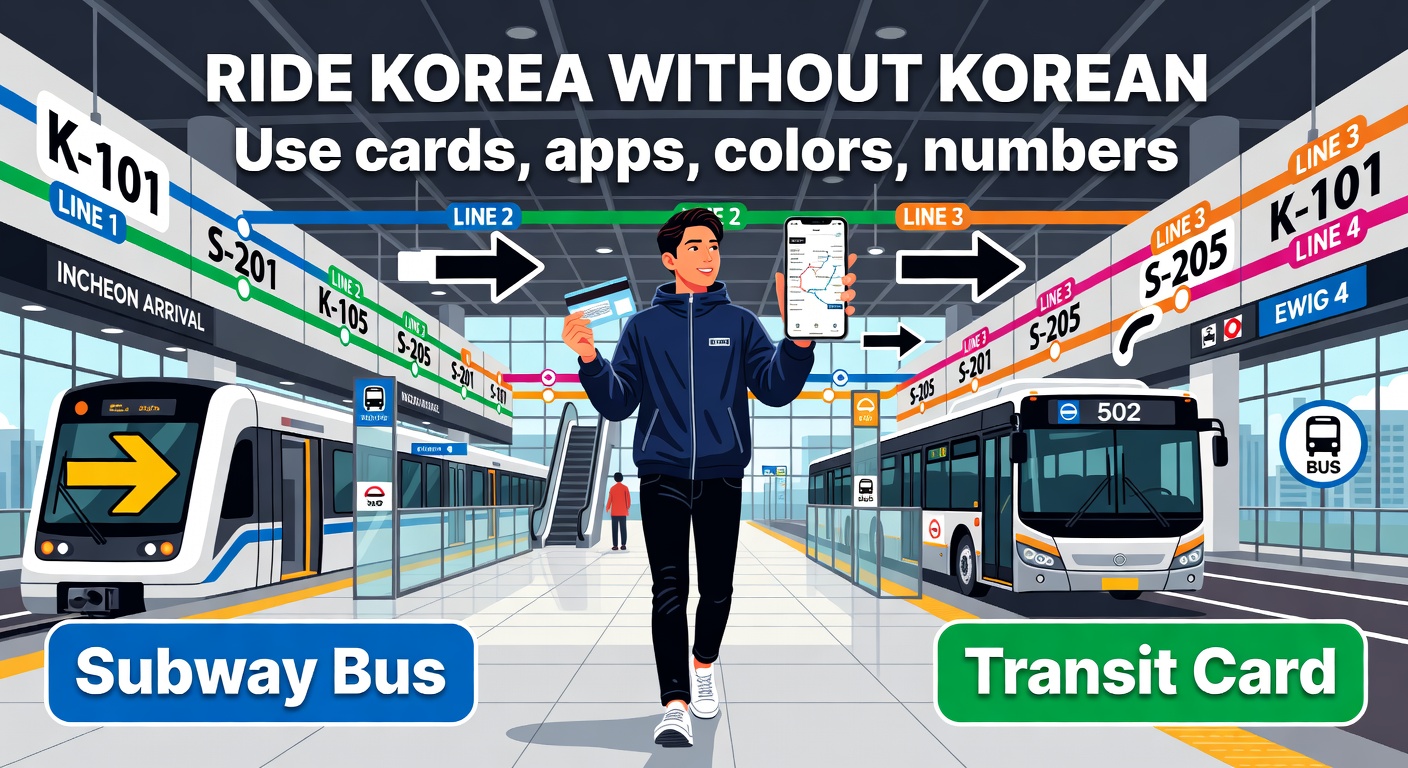
Here is the reassuring truth: Korea's transit system runs on colors, numbers, and apps — not conversations. This article walks you through exactly how to get a transit card, ride the subway and buses, and use the right apps so you can move around Seoul (and beyond) without needing a single word of Korean.
Getting Your Transit Card at the Airport
The very first thing to sort out — before you even leave the arrivals hall — is your transit card. As of March 2026, foreign-issued credit and debit cards still cannot tap directly at subway gates or bus readers. That means you need a Korean transit card, and Incheon Airport is the easiest place to grab one.
You have three main options: the standard T-money card, the tourist-oriented Korea Travel Card, and the unlimited-ride Mpass. A basic T-money card costs 3,000–5,000 won at any GS25 or CU convenience store inside the airport. Load it with 20,000–50,000 won — a comfortable starting amount for a few days. The Mpass is designed for short-stay visitors who plan to ride heavily — it covers Seoul subway, city buses, and the AREX airport express at a fixed package price.
Many people find the card choices confusing because the names sound similar and the coverage overlaps. The simplest way to think about it: T-money is for everyone and works almost everywhere in Korea, while Mpass and Korea Travel Card are tourist-specific products with bundled perks but narrower coverage.
| Card | Who it's for | Price | Coverage | Best if you… |
|---|---|---|---|---|
| T-money | Anyone | 3,000–5,000 ₩ + top-up | Nationwide transit, taxis, convenience stores | Stay 4+ days or travel outside Seoul |
| Mpass | Foreign tourists | 15,000 ₩ (1-day) – 64,500 ₩ (7-day) | Seoul subway, city buses, AREX (up to 20 rides/day) | Take many rides daily for 1–7 days |
| Korea Travel Card | Foreign tourists | 4,000–10,000 ₩ + top-up | T-money transit + partner shop discounts | Want shopping/dining perks alongside transit |
| Single-journey ticket | Anyone | Fare + 500 ₩ deposit | One subway ride only | Ride once or twice and leave |
One detail that trips people up: the Mpass does not cover KTX trains, intercity express buses, or some local village (maeul) bus routes. If your itinerary includes a day trip to Busan by train, you will still need to buy that ticket separately.
Before you leave the airport, also make sure you have mobile data sorted — either a local SIM, eSIM, or pocket Wi-Fi. The apps that will save you on transit all need internet, and they work best with a Korean data connection.
The Apps That Replace Korean Fluency
If you install only two apps before your trip, make them Naver Map and KakaoMap. Both offer English interfaces, real-time transit routing, and step-by-step navigation that tells you exactly which platform to stand on and which exit to take. Between the two, Naver Map tends to have slightly better English support for transit directions, while KakaoMap is popular for its taxi-hailing integration.
Here is how they work in practice: you type your destination in English (or paste the Korean name — more on that in a moment), and the app shows you every route option — subway, bus, walking, or a combination. It tells you the estimated time, cost, number of transfers, and even which subway car to board for the fastest exit. When you are on the train, the app tracks your location in real-time and alerts you before your stop.
A common pain point people mention in reviews is that some place names do not come up when searched in English. Tourist landmarks usually work fine, but a random neighborhood restaurant or a small clinic might not. The workaround: copy the Korean name (한글) from a website, Google result, or message and paste it directly into Naver Map. The app handles Korean input perfectly even if you cannot read it yourself.
Now that your card is loaded and your phone is set up, the actual riding part is simpler than you expect.
Riding the Subway — Colors and Numbers Do the Talking
Seoul's subway system is one of the most foreigner-friendly in Asia, and that is not an exaggeration. Every station displays its name in hangul, English, and Chinese. Every line has a distinct color and number. Every station has a unique three-digit code (for example, Gangnam is 222 — Line 2, station 22). You can navigate the entire network just by matching colors and numbers, without reading a single Korean character.
Here is the basic flow. You enter the station, find the turnstile, and tap your T-money card on the reader. A small screen confirms the deduction. Head to the platform for your line — the overhead signs show the line color, direction, and terminal station name in English. Board the train, watch the screen inside the car (it shows upcoming stations in English), and get off at your stop. Tap out at the exit turnstile. Done.
The part where most people get confused is large transfer stations. A station like Seoul Station or Jongno 3-ga connects multiple lines, and the walking distance between platforms can be surprisingly long — five to ten minutes in some cases. Naver Map will tell you exactly which direction to walk after exiting the train, but if you lose signal underground, follow the colored line markers painted on the walls and floors. They literally guide you from one platform to another.
Exit numbers matter too. Big stations can have 20+ exits, and choosing the wrong one might put you on the opposite side of a wide avenue with no easy crossing. Your navigation app will specify an exit number — trust it, and match it to the signs inside the station before you climb the stairs.
If you only need to ride the subway once or twice and do not want to buy a T-money card, single-journey tickets are available from machines at every station. The machines have an English language option. You pay the fare plus a 500-won refundable deposit, and after your ride, you feed the ticket into a deposit return machine near the exit turnstiles. Just know that single-journey tickets do not get the transfer discount.
Taking the Bus — Harder but Still Manageable
Buses are where the language barrier gets a bit more real. Unlike subway stations, bus stops often have limited English signage, and the route maps posted at stops are almost entirely in Korean. But with the right approach, buses are absolutely usable — and sometimes they are the faster, more direct option.
Seoul's bus system uses a color-coding scheme that tells you the type of route at a glance. Blue buses are trunk routes running long distances across the city. Green buses are feeder routes connecting neighborhoods to subway stations. Yellow buses loop around specific districts (great for tourist areas like Jongno). Red buses are express routes to the suburbs. Knowing just the color already narrows down what a bus does.
The key to riding buses without Korean is doing your route search before you get to the stop. Open Naver Map or KakaoMap, search for your destination, and look at the bus option. The app will show you the bus number, which stop to wait at, how many stops until yours, and an estimated arrival time. Some apps even send a vibration alert one stop before yours.
When the bus arrives, board through the front door and tap your T-money card on the reader. Find a seat or hold a rail. Watch your phone — the app tracks your position in real-time and alerts you before your stop. Pressing the stop button is the local custom, so go ahead and press it.
The free transfer system is one of the best features of Korean transit — and also one of the most commonly misunderstood. When you tap off one bus (or subway) and tap onto another within 30 minutes and 10 kilometers, the transfer is free, up to four transfers total. This means a subway-to-bus or bus-to-bus trip can cost the same as a single ride, as long as you stay within the window. But the system only works if you tap off properly every time.
Taxis When Transit Is Not Enough
Sometimes the subway does not go where you need, or it is past midnight. Taxis in Korea are affordable compared to most Western countries, and you can use them without speaking a word of Korean thanks to ride-hailing apps.
Kakao T is the dominant taxi app. Set the interface to English, type or paste your destination, and request a ride. The driver sees the destination on their screen, so no verbal communication is needed. When flagging a taxi on the street — which still works fine in Seoul — the trick is to have your destination displayed in Korean on your phone screen. Open Naver Map, search the place, and show the Korean name and address to the driver. Most drivers will read it and start driving.
Regular taxis (silver or white) use a meter. The base fare in Seoul is around 4,800 won as of early 2026, and it goes up with distance and time. Late-night surcharges apply after midnight. Black "mobeom" (deluxe) taxis cost more but offer more space and a slightly more polished experience — whether the premium is worth it depends on your priorities.
Understanding Fares and the Transfer System
Korean public transit fares are distance-based and surprisingly affordable. A basic subway ride starts at 1,400 won (about $1 USD) with a T-money card, and buses cost roughly the same. Paying with a transit card automatically gives you a 100-won discount compared to cash or single-journey tickets.
The transfer discount is the system's hidden superpower. As long as you tap on within 30 minutes of tapping off your previous ride, and the combined extra distance stays within 10 km, you pay only the distance-based difference — often nothing at all. You get up to four free transfers per trip chain. This makes it possible to cross Seoul on a subway-bus-subway combination for barely more than the price of one ride.
When your trip is over and you are heading home, you can get a refund on your T-money card balance. If the remaining amount is under 50,000 won, any GS25 or CU convenience store can process the refund (minus a 500-won fee). For larger balances, head to the T-money Town counter at Seoul Station.
Survival Phrases You Might Actually Need
You can genuinely get through weeks in Korea without speaking Korean on transit. But a handful of phrases make the occasional interaction smoother — like asking a station attendant for help or confirming you are at the right stop.
"여기 어디예요?" (yeo-gi eo-di-ye-yo?) — "Where is this?" Useful when you are disoriented and want to confirm your location. Point at a map or your phone screen while asking.
"이거 [station name] 가요?" (i-geo [station name] ga-yo?) — "Does this go to [station name]?" Works on buses when you want to double-check the route.
"내려주세요" (nae-ryeo-ju-se-yo) — "Please let me off." Helpful if you are standing near the back of a crowded bus and need people to make way.
"감사합니다" (gam-sa-ham-ni-da) — "Thank you." Not transit-specific, but saying it when exiting a taxi or receiving help from station staff goes a long way.
You absolutely do not need to memorize these. Screenshot them, keep them in a notes app, or save this article. The point is having them ready when you need them, not performing fluent Korean.
Which Card Should You Actually Get?
This is the decision most first-time visitors agonize over, so here is the straightforward answer.
If you are truly only riding the subway once to get from the airport to your hotel and then taking taxis the rest of the trip, a single-journey ticket is fine. But for almost everyone else, the T-money card is the default safe choice — cheap, universal, and easy to refund when you leave.
Conclusion
Korean public transportation does not require Korean. It requires a transit card, a navigation app, and a basic understanding of the color-and-number system that Korea has built specifically to make its transit accessible. Buy your T-money or Mpass at the airport, install Naver Map, and tap your way through the subway and buses the same way millions of residents do every day. The system was designed to be visual and intuitive, and once you take your first ride, you will wonder why you were worried at all.
Frequently Asked Questions
Q. Can I use Apple Pay or Google Pay on Korean subway?
As of March 2026, foreign mobile wallets cannot tap at subway gates or bus readers in Korea. You need a physical transit card like T-money, Mpass, or Korea Travel Card. Open-loop payment support for foreign cards is expected to roll out gradually from 2027.
Q. How much does a T-money card cost for tourists?
The card itself costs 3,000–5,000 won (roughly $2–4 USD) at convenience stores and airport counters. You then load money onto it separately — most visitors start with 20,000–50,000 won depending on their length of stay. Unused balance under 50,000 won is refundable at convenience stores for a 500-won fee.
Q. Is the Mpass unlimited pass worth it for a 3-day trip to Seoul?
If you plan to take four or more rides per day, the 3-day Mpass at 30,500 won is likely cheaper than paying per ride. It covers Seoul subway, city buses, and the AREX airport train. However, it does not work on KTX, intercity buses, or transit outside Seoul, so factor in your itinerary before deciding.
Q. Do Korean buses have English announcements?
Major routes and stops near tourist areas often have English announcements, but many regular city bus routes announce stops only in Korean. The most reliable workaround is tracking your ride in Naver Map or KakaoMap, which shows your real-time position and alerts you before your stop regardless of the bus announcement language.
Q. What happens if I forget to tap my T-money card when getting off the bus?
The system records your boarding stop but cannot calculate the correct fare, so it may charge you the maximum distance fare for that route. You also lose the free transfer benefit for your next ride. Make it a habit to always tap the card reader near the rear door when exiting — it takes one second and saves you money.

Korea Travel Guide Creator
Practical Korea travel, food, and culture guides for foreign visitors.
View all posts →